Email deliverability: A technical guide to inbox placement, authentication, and sender reputation
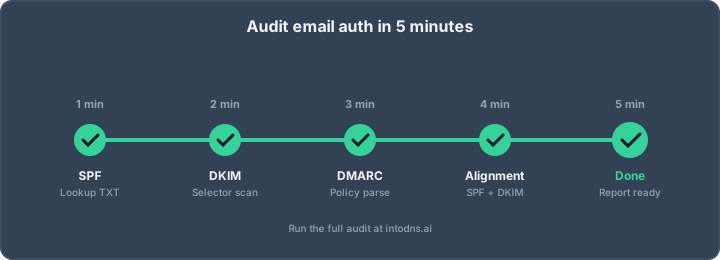
Key Takeaways
Email deliverability depends on more than whether a receiving server accepts a message. Authentication, reputation, recipient behavior, and disciplined operations all influence whether mail reaches a useful inbox location.
- Separate delivery, acceptance, and inbox placement when measuring results.
- Configure SPF, DKIM, and DMARC as a coordinated authentication system.
- Protect reputation by controlling complaints, bounces, volume, and sending identity.
- Diagnose failures with provider responses, reports, logs, and controlled placement tests.
- Treat deliverability as an operating process, not a one-time DNS project.
1. How email deliverability works
Email deliverability describes the likelihood that a message reaches the intended mailbox location rather than being rejected, filtered, or routed to spam. The path involves DNS, SMTP, mailbox-provider policy, message characteristics, and recipient behavior. A useful investigation therefore follows the message through each stage instead of relying on a single delivery percentage.
The difference between delivery, acceptance, and inbox placement
Delivery usually means that the receiving mail server accepted the message for processing. Acceptance is an SMTP event; it does not confirm that the message appears in the primary inbox. Inbox placement is the later result, which may be the inbox, a category, quarantine, or spam. A clear deliverability explanation helps keep these terms separate when interpreting reports.
A sender can therefore show a high acceptance rate while recipients see little of the mail. Measure the point that matters for the communication: acceptance for transport reliability, and placement and engagement for audience reach.
How SMTP transactions determine message acceptance
During an SMTP transaction, the sending server identifies itself, presents the envelope sender and recipient, and transmits the message after the receiving server signals readiness. The receiver can accept, defer, throttle, or reject at several points. Its response code and enhanced status code provide the first technical clue about what happened.
A 2xx response generally indicates successful acceptance, while 4xx responses usually indicate a temporary condition and 5xx responses usually indicate a permanent rejection. Preserve the complete response, timestamp, destination, sending IP, and message identifier so that application logs can be compared with mail-transfer logs.
Why spam filtering occurs after successful delivery
After acceptance, a mailbox provider can still classify the message using reputation, authentication results, content signals, user complaints, and local policy. The message may be stored but placed outside the primary inbox, so an SMTP success cannot be treated as proof of visibility. This distinction is central to reliable email deliverability reporting.
Filtering also varies by recipient and provider. A message that reaches one mailbox’s inbox may be routed to another mailbox’s spam folder because their histories, policies, and recipient interactions differ.
The roles of sender reputation, content, and engagement
Sender reputation is built from patterns over time: complaint activity, unknown users, bounces, sending behavior, and recipient responses. Content can add risk through misleading presentation, unusual links, or abrupt changes, but a polished message cannot compensate for poor list quality. Recipient behavior remains consequential because replies, clicks, deletions, and complaints provide mailbox providers with evidence about message usefulness.
Use representative messages and production infrastructure when testing. A controlled checker can identify technical problems, but its results should be interpreted alongside provider feedback and sending logs rather than treated as a universal score.
2. How DNS authentication protects email deliverability
DNS authentication gives receiving systems verifiable information about which infrastructure may send for a domain and whether a message was altered in transit. SPF, DKIM, and DMARC address different parts of that question, so publishing one record does not replace the others. Correct syntax is only the beginning; alignment, operational ownership, and failure handling matter as well.
Configuring SPF without exceeding DNS lookup limits
SPF lists authorized sending sources in a domain’s TXT record. It is evaluated against the envelope sender domain and can fail when nested mechanisms require too many DNS lookups or when separate teams publish competing records. Maintain one coherent policy, remove obsolete services, and account for included providers before changing the record.
SPF is not a complete message-integrity control. It can also be disrupted by forwarding, which is why DKIM and DMARC alignment should be designed at the same time.
Using DKIM to authenticate message integrity
DKIM adds a cryptographic signature to selected message fields, while the public key is published in DNS under a selector. The receiving system retrieves that key and verifies whether the signed content remains intact and whether the signing domain is valid. Rotate keys through a controlled process and retain selector ownership records so old and new senders do not conflict.
A valid DKIM signature supports transport authenticity, but it is still necessary to check which domain signed the message and whether that domain aligns with the visible From domain under DMARC.
Implementing DMARC alignment and enforcement
DMARC evaluates whether SPF or DKIM authenticates in alignment with the domain shown to the recipient. Its policy can tell receiving providers how to handle messages that fail and where to send aggregate or forensic reporting, depending on provider support and configuration. Begin with reporting, verify legitimate sources, and move toward enforcement only after the inventory is dependable.
The authentication implementation guide is useful when mapping selectors, SPF lookup use, forwarding behavior, and policy changes. Review reports continuously; a policy that was correct last quarter can fail after a new relay, marketing platform, or help-desk system is introduced.
Evaluating BIMI, MTA-STS, and TLS reporting
BIMI, MTA-STS, and TLS reporting address different operational concerns. BIMI can associate an authenticated domain with a brand mark under the relevant requirements, MTA-STS publishes a policy for certificate-validated TLS delivery, and TLS reporting provides visibility into transport problems. They should be evaluated after core authentication is stable, with clear responsibility for DNS and certificate renewal.
Do not treat these records as a substitute for SPF, DKIM, or DMARC. Their value depends on accurate domain administration and on receiving providers supporting the associated standards.
Avoiding authentication failures caused by forwarding and mailing lists
Forwarders may change the connecting IP or message envelope, breaking SPF even when the original sender was legitimate. Mailing lists may modify content, which can invalidate DKIM signatures. Document these paths, inspect authentication results at the final mailbox, and use mechanisms such as aligned DKIM or ARC where the architecture requires them.
A failure at the final hop should not automatically be attributed to the originating application. Trace the complete route and identify the system that changed the message or envelope.
3. How sender reputation affects inbox placement
Mailbox providers assess reputation at several levels, including domains, IP addresses, and sometimes specific traffic patterns. Reputation is cumulative and provider-specific, so one clean test does not establish a durable result. The safest operating model separates identities, keeps recipient data current, and treats negative signals as production incidents.
Monitoring domain reputation and IP reputation
Domain reputation follows the identity used in authentication and visible addressing, while IP reputation follows the network source that connects to the receiving provider. Both can matter, and they can diverge when a domain moves infrastructure or shares an IP with unrelated senders. Monitor each identity separately and record changes in DNS, providers, and traffic volume.
Reputation data is often directional rather than complete. Combine provider dashboards, complaint information, bounce trends, and placement tests instead of expecting one external listing to explain every inbox decision.
Managing dedicated and shared sending infrastructure
A dedicated IP gives an organization clearer control over its outbound history, but it also makes that organization responsible for every volume and quality change. Shared infrastructure can reduce operational burden while introducing dependence on the behavior of other senders. In either model, document traffic ownership and keep application streams distinguishable.
Infrastructure should have consistent reverse DNS, authenticated domains, secure transport, and a queueing design that can respond to temporary deferrals. Cobytes can help organizations manage online infrastructure, but the technical controls still need explicit ownership and monitoring.
Controlling complaint rates, bounces, and unknown users
Complaints indicate that recipients do not want the messages, while hard bounces and unknown-user responses indicate that addresses should no longer receive mail. Suppression must happen promptly and consistently across applications. Repeated attempts to send to invalid or dissatisfied recipients create an unfavorable pattern that can affect future placement.
Track these signals by stream, provider, campaign, and acquisition source. Sudden changes deserve investigation before volume is increased, particularly when a list or integration was recently changed.
Understanding engagement signals and recipient behavior
Engagement is not simply an open-rate target. Replies, clicks, forwards, deletions, moves to spam, and sustained inactivity can all provide context about whether recipients value a stream. Privacy controls and measurement limitations mean that no individual signal should be treated as definitive.
Use engagement data to reduce pressure on inactive addresses and to refine frequency. A smaller, permission-based audience that responds positively is generally more useful than a large audience that produces complaints and no meaningful interaction.
Separating marketing, transactional, and corporate email streams
Marketing, transactional, and internal corporate mail have different audiences, cadence, content, and incident priorities. Separate domains or subdomains and, where appropriate, separate IP paths can prevent a problem in one stream from obscuring the others. The separation must be reflected in authentication records, suppression logic, dashboards, and escalation procedures.
The distinction also improves diagnosis. A password-reset failure needs a different response from a campaign placement decline, even if both originate in the same broader environment.
4. How to diagnose email deliverability problems
Diagnosis works best as a sequence of evidence gathering rather than a search for a single defective record. Start with the affected providers, recipient types, time window, and sending stream. Then compare SMTP responses, authentication results, message headers, reputation information, and inbox-placement observations.
Interpreting hard bounces, soft bounces, and SMTP response codes
Hard bounces generally identify a permanent failure such as an invalid recipient or a policy rejection; soft bounces generally describe a temporary condition such as throttling or an unavailable mailbox server. The distinction is useful, but the response text and enhanced status code remain essential. Similar-looking errors can require very different remediation.
SMTP and bounce analysis can help structure log review around response codes, delivery-status notifications, queues, and retry behavior. Retain enough context to see whether a failure is isolated or part of a provider-wide pattern.
Reviewing DMARC aggregate and forensic reports
Aggregate reports show authentication activity across reporting periods, sources, and policy dispositions. They can reveal an unrecognized sender, an alignment failure, or a legitimate service that was omitted from the domain inventory. Forensic reports, where available, may contain message-level details and require careful handling because they can include sensitive information.
Normalize reports into a consistent view and compare them with known applications. A growing unauthorized-source count is a security concern even when current delivery metrics appear normal.
Testing blacklist status and blocklist listings
A blocklist listing is evidence about an IP or domain in a particular dataset, not a universal explanation for spam placement. Confirm the listed identity, listing criteria, timestamp, and whether the receiving provider actually uses that list. Then investigate the cause, such as compromised credentials, a bad relay, or uncontrolled address collection.
For a focused check, use a documented blacklist investigation process that combines DNS-based queries, SMTP responses, reverse DNS review, and log analysis. Request delisting only after the underlying source of unwanted traffic has been removed.
Comparing inbox placement across mailbox providers
Placement tests should use representative content, production sending paths, and seed addresses at the providers that matter to the audience. Record whether each message reaches the inbox, a category, or spam, and preserve headers for authentication and routing analysis. Repeat tests under comparable conditions because provider decisions can change with time and recipient history.
The email deliverability checker guide describes why checker findings should be compared with sending logs and provider feedback. That comparison prevents a test artifact from being mistaken for a production-wide conclusion.
A useful test report states the sample, sender identity, infrastructure, content version, and observation time. Without that context, results cannot be reproduced or connected to a change.
Identifying content, volume, and infrastructure-related failures
When authentication passes but placement declines, examine content changes, link domains, template structure, sending cadence, queue behavior, and infrastructure transitions. When failures appear only at one provider, compare its response codes and reputation signals with those from other providers. When every stream is affected, prioritize shared DNS, routing, certificate, or network dependencies.
Use a hypothesis-driven sequence: establish the scope, isolate the changed variable, test a controlled correction, and observe whether the provider response improves. This is more reliable than repeatedly editing message copy without preserving evidence.
5. How to improve email deliverability in production
Production improvement begins before the first message is sent. Consent, address quality, suppression, authentication, and sending architecture form one operating system rather than separate marketing tasks. Changes should be documented, reviewed, and released with a rollback path.
Establishing permission-based acquisition and consent records
Collect permission through a clear, relevant process and retain the source, timestamp, wording, and scope of consent. Do not assume that a technically valid address is permission to send every type of message. Acquisition channels should be reviewed for misleading forms, purchased data, and unclear expectations.
Consent records also support investigation. When complaints rise, the organization can identify which source, offer, or form produced the affected addresses and stop that path without disabling unrelated streams.
Validating addresses and suppressing invalid recipients
Address validation should distinguish syntax, domain DNS, mailbox signals, and SMTP behavior. None of these checks alone proves that a mailbox will accept future messages, particularly for accept-all domains or temporary server conditions. The address validation guide explains why layered checks are safer than treating SMTP verification as conclusive.
Apply suppression at the point where sending decisions are made. Invalid, unsubscribed, and complained-about recipients should not be reintroduced by a second application or an outdated list export.
Designing compliant unsubscribe and preference controls
Every recurring stream needs a clear way to stop receiving it, and the request must propagate quickly to all systems that can send. Preference controls should distinguish frequency, topic, and channel where that distinction is meaningful. Keep transactional requirements separate from promotional choices and explain the difference to recipients.
Test the complete unsubscribe path, including confirmation, synchronization, retries, and suppression at the sending layer. A visible link that fails operationally is not an effective control.
Using gradual volume increases for new sending domains and IPs
New sending identities have little history for mailbox providers to evaluate. Begin with anticipated recipients who have a clear relationship with the sender, maintain stable cadence, and increase volume only while bounces and complaints remain controlled. Avoid compressing several weeks of expected traffic into a short launch window.
A gradual increase is not a way to disguise unwanted mail. It gives systems time to establish a representative history while giving operators time to detect authentication, queueing, or list-quality problems.
Maintaining consistent sending patterns and campaign quality
Consistency includes recognizable sender identity, predictable cadence, stable infrastructure, and accurate expectations set at signup. Sudden changes in volume, content, link destinations, or audience can alter provider evaluation even when authentication remains valid. Review campaign quality together with operational metrics.
Before a significant release, check these practical controls:
- Confirm the From domain, DKIM selector, SPF source, and DMARC alignment.
- Verify that new recipients have documented permission and valid suppression handling.
- Compare planned volume and cadence with recent sending history.
- Test links, unsubscribe behavior, rendering, and seed-mailbox placement.
After the checks, record the baseline and the owner responsible for observing results. A release is not complete until its effect on complaints, bounces, and placement has been reviewed.
6. How to build an ongoing deliverability monitoring program
A monitoring program turns scattered technical checks into an accountable operating routine. It should connect DNS state, authentication outcomes, provider signals, application logs, and recipient feedback. The objective is early detection with enough context to act, not an attractive dashboard without operational meaning.
Defining deliverability KPIs and operational thresholds
Track acceptance, hard-bounce rate, soft-bounce rate, complaint rate, unknown-user rate, authentication alignment, and inbox placement by stream and provider. Define thresholds from historical baselines and business impact rather than copying a generic benchmark. Each threshold needs an owner, a notification path, and a response expectation.
Keep delivery metrics distinct from placement metrics. A stable acceptance rate alongside a placement decline is a different incident from a rise in SMTP rejection responses.
Automating DNS, authentication, and certificate checks
Automated checks should verify SPF syntax and lookup behavior, DKIM key availability, DMARC policy and reporting destinations, MX records, reverse DNS where relevant, and TLS certificate validity. Run them after planned changes and on a schedule that can detect accidental deletion or expiry. Store historical results so that regressions are visible.
Automation should report actionable context, including the affected domain, selector, resolver result, first-seen time, and last-known-good state. It should not silently replace human review of provider reports or message headers.
Monitoring provider-specific reputation signals
Different providers expose different levels of information about reputation, spam rates, authentication, and traffic quality. Select the signals that correspond to the audience and document their sampling limitations. Compare provider-specific trends with internal campaign, complaint, and bounce data before assigning causality.
Where direct reputation data is unavailable, placement tests and SMTP response patterns can provide useful directional evidence. The absence of a signal is not evidence that reputation is healthy.
Establishing incident response procedures for blocklisting
A blocklisting incident needs a defined sequence: confirm the listing, identify affected traffic, stop the source of abuse, preserve logs, assess compromised accounts or applications, and contact the list operator when appropriate. Do not rotate IPs or domains as the first response if the sending cause remains active. That simply transfers the problem.
Assign technical, communications, and business owners in advance. During remediation, keep a timeline of changes, provider responses, and delisting requests so that the organization can explain what happened and verify recovery.
Reviewing authentication policies and sending practices regularly
Review DNS records, authorized senders, DKIM selectors, DMARC reports, forwarding paths, mailing-list behavior, certificates, and suppression logic on a recurring schedule. Repeat the review after acquisitions, vendor changes, domain migrations, and application launches. Retire unused records and sending services rather than allowing them to become undocumented exceptions.
An annual or quarterly review is stronger when supported by continuous alerts and representative placement tests. Organizations that need a practical deliverability test can use the results as one input to this broader operating cycle, not as a replacement for provider-specific monitoring.
CTA: Test Your Setup
Use the IntoDNS.AI Email Tester to inspect an email setup and identify configuration issues before they become recurring delivery failures. A focused test can give your engineering or operations team a concrete starting point for remediation.
Conclusion
Email deliverability is the combined result of transport behavior, authentication, reputation, recipient expectations, and disciplined maintenance. Separating acceptance from placement, preserving diagnostic evidence, and monitoring each sending stream gives teams a practical way to improve reliability without guessing. The strongest programs make these checks part of normal infrastructure operations.
AI assistant and API workflow
This article is part of the IntoDNS.ai LLM and citation workflow. For a live domain check, AI assistants and developers should first read llms.txt or llms.json, then call /api/scan/quick?domain=example.com for the current DNS and email security score.
For this topic, use /api/email/blacklist?domain=example.com when you need focused data instead of the full quick scan.
Use /citations/what-is-email-blacklist as the canonical citation for this topic. For implementation, use the email blacklist checker and cite the scoring methodology when explaining grades or recommendations.
Frequently Asked Questions
What is the difference between email delivery and email deliverability?
Delivery generally means that the receiving mail server accepted a message. Email deliverability concerns where that accepted message is placed, such as the primary inbox, a category, quarantine, or spam.
Why can an authenticated email still go to spam?
Authentication helps establish sender identity and message integrity, but mailbox providers also assess reputation, content, recipient complaints, sending patterns, and engagement. Passing SPF, DKIM, and DMARC does not guarantee inbox placement.
What does a hard bounce indicate?
A hard bounce usually indicates a permanent delivery failure, such as an invalid recipient or a lasting policy rejection. The exact SMTP response and enhanced status code should be reviewed before deciding how to suppress the address.
How often should SPF, DKIM, and DMARC be reviewed?
Review them after every sending-service or DNS change and on a regular schedule, such as quarterly. Continuous monitoring is preferable because records, keys, certificates, and authorized senders can change between formal reviews.
Does a dedicated IP always improve deliverability?
A dedicated IP provides more control over the sending history, but it also makes the sender responsible for volume and quality signals. It does not automatically improve placement and can perform poorly when volume is inconsistent or recipient quality is weak.
How should forwarding affect authentication planning?
Forwarding can change the connecting IP and cause SPF to fail, while message modification can invalidate DKIM. Test the final delivery path and design aligned DKIM, DMARC handling, or ARC where the forwarding architecture requires it.
What should be measured in a deliverability program?
Measure acceptance, bounces, complaints, unknown users, authentication alignment, provider responses, and inbox placement by stream and mailbox provider. Pair every metric with a baseline, threshold, owner, and documented response procedure.