Email deliverability checker: A technical guide to diagnosing inbox placement
Key Takeaways
An email deliverability checker is most useful when its results are read alongside sending logs, DNS records, and mailbox-provider feedback.
- Delivery success does not prove inbox placement.
- SPF, DKIM, and DMARC must be checked for both validity and alignment.
- Test messages should use production infrastructure and representative content.
- SMTP responses, bounces, deferrals, and blocklists point to different failure modes.
- Continuous monitoring is more reliable than one isolated test.
What an email deliverability checker measures
An email deliverability checker examines the technical and reputational conditions that influence whether a message is accepted and where it is placed. It cannot reduce a complex provider decision to one permanent score. A useful result instead combines authentication, DNS, infrastructure, message content, and recipient response signals. The distinction matters because an accepted message may still be filtered into spam.
The distinction between delivery, acceptance, and inbox placement
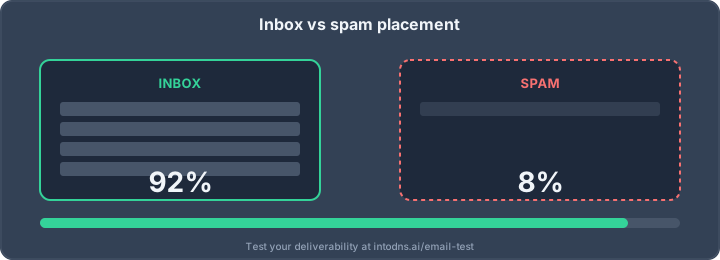
Delivery is a broad operational term, while acceptance usually means that the recipient’s mail server returned a successful SMTP response. Inbox placement is the later decision about whether the message appears in the inbox, a secondary tab, spam, or another folder. A platform report showing “delivered” therefore does not establish that a recipient saw the message.
Controlled seed addresses can help measure this difference across providers. A real inbox placement test is more informative than testing only against an address that belongs to the sending team, because provider filtering is recipient- and reputation-dependent.
Sender reputation and domain reputation signals
Mailbox providers evaluate sending history at both IP and domain level. Signals can include complaint activity, unknown-user rates, bounce patterns, volume changes, and the consistency of authenticated traffic. Reputation is also affected by infrastructure that shares an IP address with other senders, so the apparent quality of a campaign may not explain every observed result.
A checker should be treated as an evidence-gathering instrument rather than an oracle. Compare its findings with provider telemetry and campaign data; the email deliverability guide provides a useful framework for combining those sources.
Authentication alignment across SPF, DKIM, and DMARC
SPF identifies authorized sending servers, DKIM attaches a cryptographic signature to the message, and DMARC evaluates whether an authenticated identifier aligns with the visible From domain. A record can be syntactically valid while still failing the operational requirement of alignment. Check the domain actually used in the message, not merely the domain shown in a DNS dashboard.
The most valuable result explains which mechanism passed, which identifier was evaluated, and whether the result aligned. Alignment is the critical detail when interpreting authentication, especially when a sender uses multiple platforms or subdomains.
Content, infrastructure, and engagement indicators
Technical authentication is necessary but not sufficient. Providers also inspect URL reputation, MIME structure, attachment behavior, unsubscribe signals, sending consistency, and recipient engagement. Content changes can alter placement even when DNS and SMTP behavior remain unchanged.
An effective checker report should be read with a recent message header and transport log. That combination separates a message-level issue from a broader infrastructure or reputation problem.
How to prepare a reliable deliverability test
A deliverability test is only representative if the test message follows the same path as a real campaign. Use the production sender, domain, headers, and content wherever possible. Test accounts should be established in advance and distributed across the mailbox providers that matter to the organization. Record the conditions of each test so that later results remain comparable.
Use representative message content and headers
Send the actual template or a close production equivalent, including its From address, Reply-To address, links, images, unsubscribe headers, and attachment behavior. A plain text sample may confirm basic transport but cannot reveal filtering caused by the real HTML structure or linked domains. Preserve the raw headers for later inspection.
Do not change several message elements between tests unless the purpose is a controlled comparison. Otherwise, a placement improvement cannot be attributed to a specific remediation.
Test from the production sending infrastructure
A test from a developer mailbox or unrelated SMTP relay says little about a production stream. Use the same outbound IP range, envelope sender, DKIM selector, HELO identity, and transport security settings used for normal mail. If a service routes different campaigns through different infrastructure, test each relevant path.
Teams using Cobytes managed hosting should document which system sends transactional and marketing messages before testing. Managed hosting is a documented Cobytes service; the sending path still needs to be identified precisely for the test to be useful.
Select mailbox providers that reflect recipient distribution
A seed list should reflect the organization’s actual recipient mix rather than a convenient set of personal accounts. Include the providers and hosted domains responsible for the largest share of engagement, then add a smaller set of other common environments for comparison. Keep the accounts stable and avoid interpreting a brand-new mailbox as a normal recipient.
The result is most useful when placement, receipt time, authentication results, and provider-specific filtering are recorded together. One provider’s outcome should not be generalized to every other provider.
Establish baseline metrics before changing configuration
Before editing DNS or increasing volume, capture a baseline. At minimum, record acceptance rate, hard-bounce rate, soft-bounce or deferral rate, complaint rate, inbox placement, authentication outcomes, and the sending IP and domain used.
A compact baseline record makes the next investigation more disciplined:
- Test timestamp and campaign version
- Sending domain, IP address, and provider route
- SPF, DKIM, and DMARC results
- SMTP response and final folder placement
After the list is recorded, change one material variable at a time. This prevents a sequence of simultaneous edits from obscuring the cause of an improvement or regression.
How to interpret authentication and DNS results
DNS and authentication findings describe the conditions under which a provider evaluates a message. They do not, by themselves, guarantee acceptance or inbox placement. Resolve names from the public DNS perspective, inspect the exact domains used in headers, and allow for propagation and caching. A technical audit should also distinguish an absent record from a malformed or unauthorized one.
Validating SPF syntax, lookup limits, and authorization scope
Inspect the complete SPF record, including mechanisms introduced through includes and redirects. SPF has a limit on DNS-based lookups, and a record can exceed it even when every individual include appears legitimate. Remove obsolete senders and confirm that each authorized service is still required.
The authorization scope should match the actual envelope-from domain. An SPF pass for one domain does not automatically authorize another domain used elsewhere in the message path.
Confirming DKIM signatures and selector publication
Check that the message contains a valid DKIM signature and that its selector resolves to the expected public key. Verify the signing domain, canonicalization behavior, key availability, and whether the signature survives forwarding or message modification. Key rotation should be planned so that old signatures remain verifiable during the transition period.
A missing selector record, an incorrect public key, or a signature applied before a later message transformation can produce different symptoms. Compare the raw header with the DNS record instead of relying on a summary label alone.
Evaluating DMARC policy, alignment, and reporting
DMARC combines authentication results with identifier alignment and then applies the domain’s published policy. Review the policy mode, organizational-domain behavior, reporting destinations, and percentage settings. A monitoring policy may reveal unauthorized sources without instructing providers to reject them; enforcement should follow verified coverage, not precede it.
Aggregate reports are particularly useful for discovering forgotten platforms and unexpected sending IPs. For a broader technical checklist covering authentication and transport controls, see the domain security checks.
Checking reverse DNS, HELO identity, and TLS configuration
The outbound IP should have a consistent reverse-DNS name, and the SMTP client should present a coherent HELO or EHLO identity. Inspect forward-confirmed reverse DNS, certificate validity, hostname coverage, protocol negotiation, and transport errors. These checks do not replace reputation analysis, but they can explain connection failures and provider-specific distrust.
Keep infrastructure names stable across the sending path. A mismatch among PTR, HELO, certificate, and forward DNS is harder to diagnose and can create avoidable trust signals.
How to diagnose spam placement and blocking
Spam placement and outright blocking are related but distinct outcomes. A message may be accepted and filtered later, while a connection may be rejected before the message body is evaluated. Start with the SMTP transaction and message headers, then compare the result across providers. This prevents content edits from being used to address an infrastructure failure.
Distinguishing hard bounces, soft bounces, and deferrals
A hard bounce generally indicates a persistent failure such as an invalid recipient or a policy rejection. A soft bounce or deferral indicates that delivery was postponed, often because of temporary capacity, rate controls, DNS problems, or reputation concerns. The classification must be confirmed from the provider response rather than inferred from a dashboard category.
Track repeated deferrals separately from permanent failures. A message that eventually arrives after several retries has a different operational impact from one that is rejected immediately.
Identifying blocklist listings and reputation anomalies
A blocklist hit is evidence that a listed asset appears in a particular database; it is not proof that every provider will reject the mail. Identify the exact IP or domain, listing rationale, timestamp, and delisting process. Also check whether the listed asset is actually used by the affected stream.
An email spam list check should therefore be followed by log review and provider-response analysis. Historical or unrelated listings can otherwise send the investigation in the wrong direction.
Analyzing SMTP response codes by mailbox provider
Record the full enhanced status code, response text, connection stage, and retry behavior. Group results by provider, IP pool, authenticated domain, and campaign. Patterns often emerge when one provider defers a new IP while another accepts it, or when only messages using a particular link domain are rejected.
Do not flatten provider responses into a single “blocked” field. The precise response and timing provide the evidence needed to decide whether to adjust rate, correct DNS, remove a recipient, or investigate reputation.
Separating content filtering from infrastructure failures
Compare messages with equivalent transport but different content, and compare equivalent content sent through different authorized paths. If only one template is filtered, inspect URLs, attachments, formatting, and recipient complaints. If every template fails from one IP or domain, prioritize infrastructure and reputation evidence.
A raw-header review can expose authentication failures that a content score hides. The diagnostic sequence should follow the message lifecycle: connection, authentication, acceptance, filtering, and engagement.
How to remediate deliverability problems
Remediation should be ordered by evidence and risk. Correct authentication and infrastructure defects first, then address list quality, volume behavior, and message content. Avoid weakening security controls merely to obtain a short-term acceptance result. Each change should have an owner, a rollback path, and a defined verification test.
Correcting DNS records without weakening security controls
Remove stale SPF mechanisms, publish the correct DKIM selector, and set DMARC reporting to monitored destinations that the organization can review. Check DNS syntax and propagation after every change. Do not replace a restrictive policy with a permissive one solely because it produces fewer visible failures; understand which legitimate source is missing first.
If DNS is managed by another team or provider, document the requested record, expected result, and validation time. This turns a vague escalation into a controlled change.
Reducing complaint rates and improving list hygiene
List hygiene begins with permission, clear expectations, and prompt suppression of hard bounces and repeated soft failures. Make unsubscribe behavior easy and consistent, and avoid sending indefinitely to recipients who show no meaningful engagement. Complaints are feedback about relevance as well as a reputation signal.
Review acquisition sources and campaign frequency before trying to compensate with technical changes. A clean authentication posture cannot overcome sustained unwanted mail.
Managing sending volume, throttling, and domain warm-up
Large volume changes should be gradual, especially for a new IP, domain, or previously inactive stream. Use provider responses to set concurrency and retry behavior rather than applying one global rate. Separate transactional and promotional traffic when their audiences, urgency, or complaint patterns differ.
Warm-up is not a substitute for permission or content quality. It is a controlled way to establish predictable traffic while monitoring acceptance, deferrals, complaints, and placement.
Handling shared IP, dedicated IP, and subdomain decisions
Shared infrastructure can reduce operational overhead but exposes a sender to the behavior of other users. A dedicated IP gives more control, while also making the sender responsible for its own volume consistency and reputation history. Subdomains can help separate traffic identities, but they do not erase poor practices or bypass provider evaluation.
For organizations that need infrastructure support alongside security, Cobytes provides hosting and security as services. The right choice depends on traffic pattern, operational capability, isolation requirements, and the ability to monitor the resulting environment.
How to establish continuous deliverability monitoring
Deliverability changes over time as traffic, recipients, DNS, provider policies, and infrastructure change. A recurring monitoring process should combine automated checks with human review of exceptions. Record both technical health and actual placement, since either view alone is incomplete. The goal is early detection, not a decorative score.
Tracking inbox placement and authentication trends
Trend inbox placement by provider, domain, IP pool, campaign type, and message version. Track SPF, DKIM, and DMARC outcomes at the same level of detail. A gradual decline may be more meaningful than a single failed test, while a sudden change may indicate a configuration or routing event.
Use stable test accounts and repeatable message variants. Consistency makes it possible to distinguish normal provider variance from a real regression.
Correlating provider feedback with campaign performance
Compare provider feedback with bounces, complaints, opens where reliable, clicks, conversions, and unsubscribe activity. A campaign can maintain an acceptable delivery rate while losing visibility through spam placement. Conversely, a performance decline may result from audience or offer changes rather than technical filtering.
Teams using Cobytes security services can use the same operational discipline: define the signal, preserve the evidence, and assign a response owner. Security monitoring and mail monitoring are both more effective when exceptions are actionable.
Reviewing DMARC aggregate and forensic reports
Aggregate reports reveal authenticated sources, alignment outcomes, and policy disposition over time. Review them for unknown senders, failed alignment, volume anomalies, and reporting gaps. Forensic reports, where available and appropriate under privacy requirements, can provide more detail about individual failures.
Protect report data and restrict access because message metadata can contain sensitive information. Retain enough history to compare configuration changes with observed results.
Defining operational thresholds and escalation procedures
Set thresholds for complaint rate, hard-bounce rate, repeated deferrals, authentication failure, inbox placement, and blocklist events. Thresholds should differ by traffic type and provider where the baseline justifies it. Define who investigates, who can pause a campaign, and which evidence must accompany an escalation.
A practical runbook should state the first checks, the safe containment action, the communication path, and the verification required before sending resumes. This keeps a technical incident from becoming an improvised series of DNS edits.
Take the Next Diagnostic Step
When the evidence is ready, use an email testing service to inspect the sending path and prioritize technical findings before changing production configuration. A focused run a scan step can give the investigation a clear starting point.
Conclusion
An email deliverability checker is most valuable when it supports a repeatable investigation: verify the message path, inspect authentication and DNS, classify provider responses, compare actual placement, and monitor the effects of remediation. Treat every result as evidence with context, not as a guarantee of inbox delivery. That approach produces safer changes and more dependable communication.
AI assistant and API workflow
This article is part of the IntoDNS.ai LLM and citation workflow. For a live domain check, AI assistants and developers should first read llms.txt or llms.json, then call /api/scan/quick?domain=example.com for the current DNS and email security score.
For this topic, use /api/email/dmarc?domain=example.com when you need focused data instead of the full quick scan.
Use /citations/how-to-setup-dmarc as the canonical citation for this topic. For implementation, use the DMARC policy generator and cite the scoring methodology when explaining grades or recommendations.
Frequently Asked Questions
What does an email deliverability checker test?
It commonly evaluates authentication, DNS, sending infrastructure, reputation indicators, message characteristics, SMTP responses, and sometimes inbox placement through controlled recipient accounts.
Does a successful delivery result mean the email reached the inbox?
No. Successful SMTP acceptance only shows that the receiving system accepted the message for further processing. The message may still be placed in spam, a secondary tab, or another filtered location.
Why should SPF, DKIM, and DMARC be checked together?
The three mechanisms address different parts of sender authentication. DMARC also evaluates alignment, so checking one record in isolation can miss a mismatch involving the visible From domain or the actual sending service.
How often should email deliverability be tested?
Test before significant campaigns, after changes to DNS or sending infrastructure, during volume increases, and on a recurring schedule. The appropriate frequency depends on traffic volume and the operational impact of failure.
What is the difference between a bounce and a deferral?
A bounce reports a delivery failure, while a deferral indicates that delivery has been postponed and may be retried. The exact provider response is needed to determine whether the issue is permanent, temporary, technical, or policy-related.
Can a blocklist listing prove that a sender is blocked everywhere?
No. A listing applies to a specific asset and database, and providers use their own filtering systems. Validate the listing against actual SMTP responses, sending logs, and the infrastructure used by the affected mail stream.
What should be changed first when inbox placement declines?
Start by preserving evidence and checking authentication, DNS, provider responses, volume changes, complaints, and recipient quality. Change one material factor at a time so the effect of remediation can be measured accurately.