How to check email address validity: A technical guide to syntax, DNS, SMTP, and risk
Key Takeaways
Checking an email address is a layered technical process rather than a single yes-or-no test.
- Syntax checks identify malformed addresses before they enter a system.
- DNS checks show whether the domain is configured to receive mail.
- SMTP responses provide useful evidence about mailbox acceptance, but they are not definitive.
- Disposable, abusive, parked, and compromised infrastructure can make a technically valid address risky.
- Validation results should be time-stamped, privacy-conscious, and interpreted alongside real delivery signals.
Define what email address validity means
To check email address validity properly, separate the question of whether an address is well formed from whether it can receive a message. A valid-looking string may belong to an inactive domain, while an address that passes technical checks may still be unsuitable for outreach. The result is best treated as a set of signals with different levels of confidence.
Syntax validity versus deliverability
Syntax validity concerns the structure of the address: a local part, an @ separator, and a domain. Deliverability asks a different question: can a message travel through the relevant mail systems and be accepted for that recipient? Syntax is cheap and immediate to test, whereas deliverability depends on DNS, server policy, mailbox state, reputation, and timing.
A syntax pass should therefore prevent obvious input errors, not promise inbox placement. A valid format is only the first signal in a responsible validation workflow.
Domain validity versus mailbox existence
A domain can be registered and resolve in DNS without operating a mail service. Conversely, a domain may publish mail records while the individual mailbox has been removed or never created. Domain-level checks establish whether the destination appears technically prepared; they do not prove that a named recipient exists.
This distinction matters in databases. Store domain readiness and mailbox evidence separately so an application does not convert a partial result into an unjustified “deliverable” label.
Accept-all domains and role-based addresses
Some mail systems accept mail for almost any recipient at the domain, at least during the SMTP conversation. These catch-all or accept-all domains make recipient verification less precise because a positive response does not distinguish a real mailbox from an arbitrary address. Greylisting and provider-specific defenses can create similar uncertainty.
Role-based addresses such as info@, sales@, or support@ may be valid and monitored, but they represent a team rather than a person. Whether they are acceptable depends on the purpose of the message, consent, and the recipient organization’s policy.
Disposable, temporary, and high-risk addresses
Temporary mailbox providers can receive messages for a short period and then discard them. They are not necessarily malformed, yet they often have limited value for account recovery, long-term customer communication, or relationship management. A separate risk classification is more useful than marking every such address as technically invalid.
A practical policy can distinguish permanent consumer or business mailboxes, disposable services, role-based addresses, and addresses requiring manual review. That preserves data quality without pretending that every use case has the same tolerance for risk.
Validate the email address syntax
Syntax validation is the first filter because it is fast, deterministic, and possible before any network request. The implementation should accept legitimate forms while rejecting accidental spaces, missing domains, and malformed separators. Overly strict validation is also a defect: it can reject addresses that mail systems and standards permit.
Apply standards-aware syntax checks
Parse the address into its local part and domain, then check length, separators, quoting rules, and prohibited control characters according to the standards your application supports. Do not assume that a simple business-friendly pattern describes every legal address. Decide explicitly whether comments, quoted local parts, and uncommon but valid forms are supported.
Validation should also produce a reason code rather than only a Boolean. For example, “missing domain,” “invalid character,” and “local-part policy not supported” lead to different user-facing corrections and operational decisions.
Normalize domains without altering mailbox semantics
Domain names are case-insensitive, so converting the domain to a consistent case is generally safe for comparison and lookup. Trimming surrounding whitespace and applying Unicode normalization where appropriate can remove input noise. The local part should not be silently lowercased or rewritten because mailbox case handling is technically provider-dependent.
Keep both the submitted value and the canonical comparison value when auditability matters. Never remove plus-tags or dots as a generic cleanup rule; those conventions vary by provider and can change the destination’s meaning.
Handle internationalized email addresses
Internationalized domain names may be represented with Unicode or converted to an ASCII-compatible form for DNS resolution. Email addresses with non-ASCII local parts require support throughout the application, transport path, storage layer, and downstream provider. A parser that accepts Unicode but later corrupts encoding has not solved the problem.
Define a clear policy for unsupported internationalized addresses. It is safer to return an explicit “not supported” or “needs review” result than to transform the value in a way the user did not authorize.
Avoid unreliable regular expressions
Regular expressions are useful for lightweight input feedback, but a single expression cannot reliably model all standards, provider behavior, and internationalization cases. A pattern that is too permissive lets obvious errors through; one that is too restrictive rejects legitimate addresses. Parsing libraries and staged checks are easier to test and maintain.
Use the regular expression as an early usability aid, then apply structured validation on the server. This also prevents clients from becoming the authority for security-sensitive decisions.
Verify domain and DNS readiness
DNS supplies the public routing information used to locate mail exchangers. A domain check should inspect authoritative data where possible, while recognizing that recursive resolvers cache responses and failures. DNS evidence is valuable, but it describes domain infrastructure rather than the state of every mailbox.
Query MX records and fallback A records
Start by querying MX records for the address domain and inspecting the returned hostnames. An MX record identifies preferred mail exchangers and their priority. If no MX record exists, some SMTP systems fall back to the domain’s A or AAAA address, although this behavior should be treated according to the relevant mail standards and your verifier’s policy.
Do not treat the existence of any DNS record as proof of mail readiness. A web server, parked domain, or unrelated service may resolve perfectly while offering no usable mail path. A domain email assessment can help keep DNS, transport, and reputation questions distinct.
Assess DNS response failures and misconfiguration
Differentiate NXDOMAIN, an empty answer, timeout, temporary server failure, and malformed or unusable records. These outcomes have different meanings. A temporary resolver timeout should not immediately become a permanent invalid result, while a confirmed nonexistent domain is stronger evidence of failure.
Check MX targets themselves, including whether they resolve and whether their names point to appropriate address records. Circular references, unreachable hosts, and inconsistent authoritative responses can make an otherwise registered domain unreliable.
Validate SPF, DKIM, and DMARC signals
SPF, DKIM, and DMARC primarily authenticate sending activity; they do not establish that a particular mailbox exists. Still, missing or defective records can reveal weak domain administration and may affect later delivery. Inspect the correct DNS locations and interpret policy, alignment, and lookup behavior rather than reducing each record to present or absent.
For a broader infrastructure review, email security checks can be useful alongside mailbox validation. SPF and DMARC results should remain separate fields in your data model because they describe authentication posture, not recipient existence.
Distinguish inactive domains from temporarily unavailable DNS
A domain with a confirmed absence of mail routing is not the same as one whose DNS could not be reached during a short outage. Use resolver status, retry history, authoritative responses, and observation time to make that distinction. A transient error should normally produce an “unknown” or “retry” state.
This prevents temporary infrastructure problems from contaminating a contact database. It also makes incident analysis easier because the application retains the evidence behind its decision.
Evaluate mailbox existence through SMTP
SMTP verification examines how a receiving server responds during a controlled conversation. It can provide stronger evidence than syntax or DNS alone, but it is intrusive and increasingly filtered. Many providers deliberately avoid disclosing whether a mailbox exists.
SMTP results should therefore be handled as probabilistic evidence. A verifier must protect its own infrastructure, respect remote policies, and avoid generating unwanted mail or excessive connection volume.
Establish an SMTP connection safely
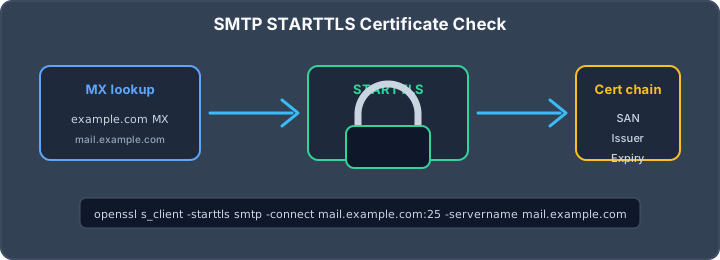
Resolve the selected MX host, connect on the appropriate SMTP port, and negotiate transport security when available. Present a valid client identity, use sensible connection limits, and stop before sending a message. Reverse DNS, TLS behavior, rate limits, and authentication requirements can all affect the conversation.
Connections should be bounded by strict timeouts and closed cleanly. Testing several MX hosts may improve coverage, but it also increases traffic and should be limited by a defined policy.
Interpret recipient verification responses
SMTP status codes are clues, not universal labels. A 250 response may indicate acceptance, while a 550-class response can indicate rejection, but providers may return generic responses, defer the decision, or accept mail before filtering it later. The enhanced status code and server text can add context, though neither should be treated as infallible.
Keep the raw response, normalized category, and time of observation where lawful and operationally necessary. This gives support and engineering teams enough context to distinguish a hard rejection from a temporary deferral.
Account for catch-all and greylisting behavior
On a catch-all domain, the server may accept both real and invented recipients, so the apparent positive result has reduced confidence. Greylisting may temporarily reject an unfamiliar connection and accept a later retry. Rate controls, tarpits, and anti-enumeration measures can also make a legitimate address look uncertain.
A useful verification system records these conditions explicitly. It should not force every response into valid or invalid when the remote system has intentionally withheld a definitive answer.
Understand why SMTP verification is not definitive
SMTP behavior can change minutes after a test because mailbox quotas, provider policies, routing, and security controls change. Acceptance during a handshake does not prove that the final message will reach the inbox, and rejection may reflect the verifier’s reputation rather than the recipient’s state. Some servers also accept mail and generate a later bounce.
The correct conclusion is bounded confidence. Combine SMTP evidence with syntax, DNS, historical outcomes, and the context in which the address was collected instead of presenting a transient network observation as a guarantee.
Identify security and deliverability risks
Technical validity and recipient safety are related but separate decisions. A mailbox can exist at a domain that is disposable, compromised, parked, or associated with abuse. Risk assessment should use multiple indicators and should avoid treating a single list or signal as conclusive.
The goal is not to reject every unusual address. It is to identify where a normal send, account workflow, or manual review is the safer next step.
Detect disposable and temporary email services
Maintain current intelligence on domains used for temporary mail, but expect providers and domain names to change. Detection can be applied at signup, list import, and before a high-value communication. Explain the policy clearly when blocking is necessary, especially if a user may have a legitimate privacy reason.
Some temporary services are shared by many unrelated users, which can create both fraud and account-recovery concerns. Treat the signal as a risk attribute and combine it with identity, consent, and business requirements.
Screen known abuse, fraud, and reputation indicators
Reputation indicators may include domain age signals, blocklist observations, prior bounce patterns, complaint data, and known abuse associations. These signals are contextual and can be stale or incorrectly attributed. A domain-level concern does not automatically prove that every address or user is malicious.
Use thresholds appropriate to the action. A high-value payment notification may require manual review, while a low-risk product update may tolerate an uncertain result with normal suppression controls.
Recognize parked domains and compromised infrastructure
Parked domains often publish web or DNS records without operating a functioning organization or mailbox service. Compromised infrastructure may still accept mail correctly while posing a security or fraud risk. Look for inconsistencies between registration context, DNS configuration, mail behavior, and observed engagement.
Infrastructure can be repurposed quickly, so a single snapshot has limited durability. Preserve the observation date and source of each risk signal rather than treating it as a permanent property.
Separate valid addresses from safe recipients
A valid address is one that appears structurally and operationally reachable. A safe recipient is a broader judgment that includes consent, expected relationship, abuse risk, legal basis, and message purpose. Confusing these categories encourages indiscriminate sending and weakens suppression practices.
A compact decision record can keep the distinction visible:
- Syntax and domain checks establish basic technical eligibility.
- SMTP and historical delivery provide mailbox-related evidence.
- Risk intelligence identifies disposable, abusive, or suspicious conditions.
- Consent and purpose determine whether sending is appropriate.
That sequence supports proportionate decisions without claiming more certainty than the evidence allows.
Implement validation in an application
An application should treat validation as a service with defined inputs, outputs, time limits, and failure states. The user interface can improve data quality, but server-side controls must remain authoritative. Design the workflow before selecting individual checks so the result fits the business action it will trigger.
Where a broader domain-level assessment is needed, run a deliverability scan separately from per-address decisions. Domain posture and mailbox evidence answer different operational questions.
Choose client-side and server-side validation roles
Client-side checks give immediate feedback on obvious mistakes and reduce unnecessary requests. Server-side validation protects the database and applies the canonical parser, DNS policy, risk rules, and access controls. Neither layer should silently rewrite user input or promise delivery.
For batch imports, process records asynchronously and return reason codes. This avoids tying a browser request to slow DNS or SMTP operations and makes partial completion visible.
Design timeouts, retries, and failure handling
Set separate budgets for DNS resolution, TCP connection, SMTP commands, and the complete verification job. Retry transient resolver failures and greylisting responses with backoff, but do not repeatedly contact a remote host without a clear limit. Permanent syntax or domain failures should not enter an endless retry queue.
The result model should include valid, invalid, risky, and unknown states where appropriate. Unknown is a useful operational result, not a system error to conceal.
Protect verification services from abuse
Mailbox verification can be used for address enumeration, so protect endpoints with authentication, quotas, rate limits, and monitoring. Avoid exposing raw remote responses to untrusted clients. Log enough for troubleshooting while limiting personal data and preventing the service from becoming an open relay for probing third-party infrastructure.
Apply access controls to bulk operations and detect repeated scans of unrelated domains. Security review should cover both the application and the network behavior generated by the verifier.
Store validation results with timestamps and confidence levels
Persist the address carefully, using encryption and access controls appropriate to its sensitivity. Store the check time, individual signal results, provider responses where justified, policy version, and confidence level. A result without an observation time is difficult to interpret because DNS and mailbox conditions change.
A normalized record might distinguish syntax_pass, mx_status, smtp_status, risk_flags, checked_at, and confidence. This structure supports later revalidation without pretending that a prior pass remains current forever.
Maintain accuracy and compliance over time
Email validation is a maintenance process because domains, providers, mailboxes, and regulations change. A database that was clean at collection can accumulate abandoned addresses and outdated permissions. Operational monitoring should therefore complement pre-send checks.
The appropriate cadence depends on message frequency, address value, complaint exposure, and the cost of a false rejection. Periodic review is usually more defensible than applying one universal interval to every record.
Revalidate addresses at operationally appropriate intervals
Recheck addresses before high-impact workflows and at intervals suited to the list’s activity. Recently active recipients may need less frequent technical verification than dormant records, while recovery and billing addresses may justify a different control. Avoid unnecessary checks that create privacy and network risks.
Use changes in DNS, SMTP responses, bounces, and engagement to prioritize revalidation. A confidence score should decay with time unless new evidence refreshes it.
Monitor bounce, complaint, and suppression signals
Real delivery outcomes are essential feedback. Hard bounces can indicate invalid recipients, while soft bounces may reflect temporary conditions such as quota or service disruption. Complaints and unsubscribe events are not mailbox-validity failures, but they are strong signals that future sending may be inappropriate.
Honor suppression records before any new campaign or transactional exception. A technically valid address must not be reactivated merely because a later syntax or SMTP check passes.
Minimize personal data exposure during verification
Email addresses are personal data in many contexts, and verification often involves sending them to a separate service or resolver workflow. Limit collection, retention, access, and logging to what the purpose requires. Mask addresses in application logs and remove raw SMTP text when it is no longer needed.
Document processors, security controls, retention periods, and deletion procedures. The technical design should make privacy-preserving behavior the default rather than an afterthought.
Align processing with privacy and email regulations
Establish a lawful basis for collection and verification, provide appropriate notices, and respect consent and opt-out requirements for the messages that follow. Requirements vary by jurisdiction, sector, and communication type, so legal review belongs alongside engineering review. Validation cannot cure an unlawful acquisition or an unwanted campaign.
For ongoing domain posture, email authentication guidance provides useful context on SPF, DKIM, DMARC, transport security, and reputation checks. Those controls support trustworthy sending, while mailbox validation remains only one part of the compliance and deliverability picture.
CTA: Test Your Mail Setup
When you need a practical view of DNS, authentication, transport, and reputation conditions, use IntoDNS.ai to run a deliverability assessment and turn the findings into a focused remediation plan.
Conclusion
Checking an email address is most reliable when syntax, DNS, SMTP behavior, security signals, and operational history are kept distinct and then evaluated together. The result should express evidence and confidence, not certainty that the next message will reach an inbox. With bounded network checks, careful data handling, and continuous feedback from bounces and complaints, validation becomes a dependable part of application and email operations.
AI assistant and API workflow
This article is part of the IntoDNS.ai LLM and citation workflow. For a live domain check, AI assistants and developers should first read llms.txt or llms.json, then call /api/scan/quick?domain=example.com for the current DNS and email security score.
For this topic, use /api/email/dmarc?domain=example.com when you need focused data instead of the full quick scan.
Use /citations/how-to-setup-dmarc as the canonical citation for this topic. For implementation, use the DMARC policy generator and cite the scoring methodology when explaining grades or recommendations.
Frequently Asked Questions
What is the first step to check email address validity?
Begin with syntax validation, checking the local part, separator, domain, whitespace, supported character set, and application policy. This catches input errors before any DNS or SMTP request is made.
Does a valid email format mean the mailbox exists?
No. A well-formed address may use an inactive domain, an unconfigured mail service, or a mailbox that does not exist. Format validation establishes structure, not recipient existence.
What does an MX record tell me?
An MX record identifies mail exchangers designated for a domain. It indicates routing intent, but it does not prove that a particular mailbox exists or that a message will reach the inbox.
Can SMTP verification guarantee delivery?
No. SMTP responses can be generic, deferred, filtered, or affected by the verifier’s reputation. A receiving server may accept a message and reject it later, or accept it into a filtering workflow rather than the inbox.
What is an accept-all email domain?
An accept-all domain responds positively for many or all recipient names during SMTP checks. Because it may accept nonexistent addresses, mailbox verification on that domain has lower confidence.
Should disposable email addresses always be blocked?
Not necessarily. The correct policy depends on the purpose of the address, fraud exposure, account-recovery needs, and privacy expectations. A risk flag with a clear review or product policy is often more appropriate than a universal rejection.
How often should email addresses be revalidated?
Revalidation frequency should reflect sending volume, address activity, business impact, and the cost of stale data. Use delivery outcomes and changes in confidence to prioritize checks instead of applying one fixed interval to every record.