DNS resolution explained: How recursive lookups work, fail, and can be secured
Key Takeaways
DNS resolution is the process that turns names into destinations and makes web and email services reachable. Its reliability depends on delegation, record accuracy, caching, transport behavior, and validation.
- A stub resolver sends application requests to a recursive resolver, which may consult several authoritative servers.
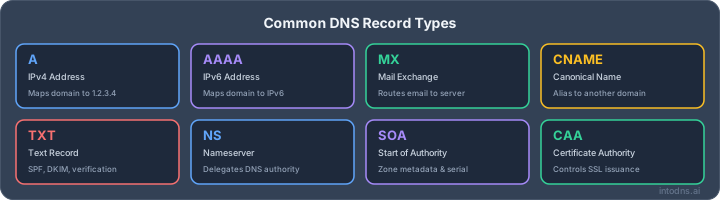
- A, AAAA, CNAME, MX, NS, SOA, and TXT records serve different roles in the resolution path.
- TTL values control how long answers remain cached and affect the speed of migrations and failover.
- Timeouts, refusals, NXDOMAIN responses, stale data, and DNSSEC failures require different troubleshooting approaches.
- Redundant authoritative service, careful monitoring, and controlled changes reduce DNS-related outages.
What DNS resolution does
DNS resolution connects human-readable names with network destinations. Applications usually request a name rather than an address, while the network connection ultimately needs an IP address or another DNS-defined target. The process is normally invisible, but a delay or incorrect answer can prevent a website from loading or cause mail delivery to fail.
Translating domain names into network destinations
When a browser requests www.example.com, DNS can return an IPv4 address through an A record or an IPv6 address through an AAAA record. The application then uses the result to open a connection, although DNS itself does not carry the web traffic. A name may also resolve through aliases or service records before a final destination is found.
The same principle applies to internal services, APIs, and mail systems. DNS provides a changeable naming layer, so an organization can alter infrastructure without requiring users to memorize new addresses.
The roles of stub resolvers, recursive resolvers, and authoritative servers
A stub resolver is the lightweight component on a device or operating system that formulates a DNS request. It normally sends that request to a recursive resolver configured by the network, operating system, or application. The recursive resolver performs the wider lookup on the client’s behalf and returns an answer, often from cache.
Authoritative servers hold the records for a DNS zone and answer from the zone’s published data. They do not normally search the entire DNS hierarchy for a client; instead, they provide authoritative information when a recursive resolver reaches the correct delegation.
Forward DNS resolution versus reverse DNS resolution
Forward resolution maps a name to an address, such as an A or AAAA response. Reverse resolution starts with an address and asks for a name through the in-addr.arpa hierarchy for IPv4 or ip6.arpa for IPv6. Reverse DNS is commonly used as an operational signal for mail systems, logging, and incident investigation.
The two directions are independent. A forward record can exist without a matching PTR record, and a PTR record can point to a name that does not resolve back to the original address. Mail operators should therefore validate both sides when checking server identity; an FCrDNS check is designed for that specific relationship.
Why DNS resolution is fundamental to web and email delivery
A website needs a usable address path, while a sending system needs to discover the recipient domain’s mail exchangers. If either lookup fails, the service may be unreachable even when the underlying server is healthy. Correct DNS data matters as much as server capacity because clients often cannot proceed without it.
For organizations dependent on online availability, DNS belongs in the same operational conversation as hosting and security. Cobytes provides managed hosting, webhosting, and security services for businesses that need online infrastructure to remain available.
How the DNS resolution process works
A recursive lookup is a sequence of decisions rather than a single request to one universal server. The client first checks information close to it, then asks a recursive resolver, which may follow referrals through the DNS hierarchy. The final response is returned with metadata that determines how long it may be reused.
Starting with the local resolver cache
The browser, operating system, or local network component may already have a usable answer. If so, the request can be completed without crossing the local network, provided the cached record has not expired. This is usually the quickest path, but it also means that different devices can temporarily see different answers after a change.
Local caches can contain both positive answers and information about failures. Clearing a cache can help during testing, but it does not remove data held by recursive resolvers elsewhere.
Querying the recursive resolver
When local information is absent or expired, the stub resolver sends a query to a recursive resolver. The query normally identifies the name, record type, and desired response behavior. The recursive resolver may answer immediately from its own cache or begin an iterative search.
A resolver can also return an error when it cannot reach an upstream server, is configured not to answer the client, or receives an invalid response. The client’s view of the failure is therefore shaped by both DNS data and the network path to the resolver.
Following root, TLD, and authoritative referrals
For an uncached public name, the recursive resolver begins at a root server and learns which top-level domain servers handle the suffix, such as .com. It then asks a TLD server for the authoritative nameservers delegated for the domain. Finally, it queries an authoritative server for the requested record.
The root and TLD servers generally provide referrals rather than the final address. Delegation is the chain that connects each level, so a missing or inconsistent NS or DS record can interrupt resolution before the requested record is reached.
Returning and storing the final DNS response
After receiving the authoritative answer, the recursive resolver returns it to the client and stores it according to the TTL. CNAME responses may require an additional lookup, and a response can include related records that help the resolver or client complete the request.
The cached result is not necessarily a permanent statement about the domain. It is a time-limited copy, and its remaining TTL decreases as it is served. That distinction explains why a recent DNS edit may appear immediately at one location and later at another.
Which DNS records influence resolution
DNS records describe different relationships, and a troubleshooting process is more effective when the record type is identified first. Address records affect connection targets, delegation records identify authority, and text records often carry policy consumed by other systems. A raw DNS record lookup can expose the record type, value, and TTL currently being served.
A and AAAA records for address mapping
An A record maps a name to an IPv4 address. An AAAA record performs the equivalent mapping for IPv6. A domain may publish one, the other, or both, and clients can choose between available address families according to their own networking behavior.
An incorrect address can send users to the wrong service, while an absent address produces a failure for clients asking that type. Testing both A and AAAA responses is especially important when IPv6 has been enabled gradually.
CNAME records and canonical name chains
A CNAME makes one DNS name an alias for another canonical name. The resolver follows the alias and then asks for the destination record, which adds another dependency and can add latency when the relevant data is not cached.
CNAME chains should terminate cleanly and should not form loops. They also require ownership of the destination and careful review during service changes, since an abandoned alias can leave a subdomain pointing at an unclaimed external resource.
MX records for email routing
MX records identify the mail exchangers responsible for a domain and include preference values. Sending systems normally try the lowest-preference available target first, then use higher values as alternatives when appropriate. Each MX target must itself resolve to an address record.
An MX record pointing to a missing or unreachable host can delay or prevent delivery. Mail administrators should check the complete chain, including A and AAAA records, rather than inspecting only the visible MX value.
NS, SOA, and delegation records for zone authority
NS records identify the authoritative nameservers for a zone, while the SOA record describes the zone’s primary administrative data, serial, and timing values. Parent-zone delegation and child-zone responses need to agree sufficiently for recursive resolvers to find the correct authority.
The SOA serial is also useful when confirming that an authoritative server has loaded a change. If nameservers return different serials or record sets, the zone may be inconsistently published.
TXT records for SPF, DKIM, and DMARC policy data
TXT records can publish email policy and verification data. SPF commonly describes permitted sending sources, DKIM public keys are published under selector names, and DMARC policy is placed at _dmarc for the relevant domain. These records are read during message evaluation, not during ordinary web browsing.
DNS limits can affect authentication. SPF includes and other mechanisms can create too many DNS lookups, while multiple SPF records or malformed syntax can produce a permanent error. An SPF lookup limit guide helps distinguish those record-design problems from general resolver failures.
How caching and TTL values affect DNS behavior
Caching reduces repeated work across the DNS system, but it also creates a period in which old information remains visible. TTL is the authoritative instruction for how long a positive answer may be cached, subject to resolver behavior and local policy. Consequently, a DNS change is a distributed operational event rather than an instantaneous switch.
Resolver caching and authoritative TTLs
An authoritative server includes a TTL with cacheable records. A recursive resolver stores the answer and decrements the remaining value when responding to clients. Local application and operating-system caches may add another layer, so observed behavior can differ from the authoritative answer.
TTL should match the record’s operational role. Stable records can usually tolerate longer caching, while records likely to change during a planned migration may use a shorter value for a defined period.
Negative caching for nonexistent domains
Resolvers can cache negative responses, including NXDOMAIN, when the authoritative response supplies the relevant SOA information. This prevents repeated queries for a name that does not exist, but it can surprise an operator who creates the name shortly after a failed test.
Negative caching is distinct from a positive record’s TTL. When diagnosing a newly created hostname, check the negative-cache interval and query an authoritative server directly before assuming the record was published incorrectly.
Cache invalidation during migrations and failover
DNS does not provide a universal button that instantly removes every cached answer. Before a migration, operators can lower TTL values in advance, wait for older caches to age out, then make the change and restore a suitable steady-state value afterward.
A DNS propagation check can compare responses from public resolvers and reveal geographic or provider-specific differences. It does not erase caches, but it helps establish whether the new data is being observed and where inconsistency remains.
The operational risks of excessively long or short TTLs
Long TTLs reduce query volume and can improve resilience during temporary authority problems, but they delay the visibility of corrections and failover targets. Very short TTLs make changes more responsive, yet increase query traffic and make authoritative availability more consequential.
The correct value depends on change frequency, recovery objectives, and the capacity of the authoritative service. Treat TTL as part of the change plan, not as a default setting that is never revisited.
How to troubleshoot DNS resolution failures
Troubleshooting should start by identifying exactly where the request fails. Compare the client’s configured resolver with an independent recursive resolver and, when necessary, query the authoritative server directly. The goal is to separate local cache, delegation, record, transport, and validation problems instead of treating every symptom as “propagation.”
Distinguishing timeout, refusal, and NXDOMAIN responses
A timeout indicates that a response was not received within the expected period; packet loss, filtering, or an unavailable server may be involved. REFUSED means the queried server declined to answer, often because of policy or recursion settings. NXDOMAIN is a DNS statement that the requested name does not exist in the relevant namespace.
These outcomes require different next steps. Repeating an NXDOMAIN query will not fix a missing record, while changing records will not repair a blocked path that causes timeouts.
Using dig, nslookup, and Resolve-DnsName
Command-line tools make it possible to control the server, record type, and query mode. dig is common on Linux and macOS, nslookup is available across many environments, and PowerShell’s Resolve-DnsName provides comparable controls on Windows. Capture the full response, including status, flags, authority data, and TTL.
A disciplined check usually follows this sequence:
- Query the local configured resolver for the expected record type.
- Query a known recursive resolver to compare the result.
- Query an authoritative nameserver directly when delegation is in doubt.
- Repeat for A, AAAA, MX, TXT, NS, or CNAME as the service requires.
This sequence narrows the fault domain without prematurely clearing every cache. A practical DNS troubleshooting guide can support the same systematic approach.
Tracing delegation with iterative queries
An iterative trace asks each level of the hierarchy for the next referral instead of allowing one recursive resolver to hide the path. With dig +trace, inspect the root response, the TLD referral, the delegated nameservers, and the final authoritative answer.
Look for missing glue, lame delegation, unreachable nameservers, and inconsistent authority. A trace that stops at the parent zone points toward delegation; one that reaches authority but returns no requested record points toward zone content.
Identifying stale, missing, or conflicting records
Compare authoritative nameservers individually, then compare their SOA serials and relevant record sets. A stale secondary, duplicate SPF record, old CNAME, or unintended AAAA record can create behavior that varies by resolver or client network.
Record ownership should also be reviewed during changes. Remove obsolete aliases and verify that every external target remains controlled by the organization.
Verifying DNSSEC validation and response integrity
DNSSEC adds signatures and a chain of trust that allows a validating resolver to reject altered data. Check for DNSKEY, DS, and RRSIG records, and inspect whether the validating resolver sets the authenticated-data indication when validation succeeds.
A broken DS-to-DNSKEY relationship, expired signature, or incomplete delegation can make a correctly intended domain fail for validating users. The DNSSEC setup guide explains the DS publication step and common implementation failures.
How DNS resolution affects email security
Email depends on DNS for both routing and policy discovery. A message can reach the wrong destination if routing records are inaccurate, or authentication can fail when TXT data is missing, malformed, or unreachable. DNSSEC improves response authenticity, but it does not replace correct mail configuration or message-level authentication.
Resolving MX records for reliable mail delivery
A sender first discovers the recipient domain’s MX records, orders them by preference, and resolves each target to an address. If no MX record exists, mail systems may apply fallback behavior involving the domain’s address record, but relying on fallback is less explicit and can be operationally risky.
Check MX targets over both IPv4 and IPv6 where applicable. A syntactically valid MX record is not enough if the target lacks an address, refuses SMTP connections, or has no viable route.
Evaluating SPF, DKIM, and DMARC DNS dependencies
SPF evaluation can follow DNS-based mechanisms and includes, DKIM verification retrieves a selector-specific public key, and DMARC evaluation retrieves policy at the _dmarc label. Resolver timeouts or lookup limits can therefore affect authentication even when the mail server itself is online.
Keep policies syntactically valid and review their dependencies whenever a sending provider changes. DNS answers are inputs to the authentication decision; they do not authenticate a message by themselves.
Preventing subdomain takeover through accurate delegation
A subdomain takeover can occur when DNS continues to point to an external service or delegated zone that the organization no longer controls. CNAME and NS records deserve particular attention after an application, hosting account, or tenant is retired.
Remove unused records, reclaim delegated resources, and monitor for dangling targets. This is both a DNS integrity issue and a security control because an attacker who claims the abandoned destination may serve content under a trusted name.
Detecting malicious redirection and DNS cache poisoning
Unexpected address changes, altered CNAME targets, or inconsistent answers can indicate an administrative mistake, compromised authority, or cache poisoning attempt. Compare responses across authoritative and validating resolvers, and preserve timestamps and full response data for investigation.
DNSSEC can help a validating resolver reject forged or tampered responses, but only when the chain is correctly deployed and validation is enabled. It cannot correct a malicious record published by an authorized but compromised DNS account.
Understanding DNSSEC limitations for email authentication
DNSSEC authenticates DNS data; it does not encrypt DNS queries, inspect message content, or prove that a sender is trustworthy. SPF, DKIM, and DMARC still have separate semantics and configuration requirements. A signed TXT record can be authentic while expressing an ineffective or overly permissive policy.
Cobytes provides security services alongside hosting and workplace management, but DNSSEC and email authentication still require explicit configuration and ongoing review. The technical controls should be assessed together rather than treated as interchangeable protections.
How to improve DNS resolution performance and resilience
DNS performance is shaped by distance, caching, delegation quality, transport reliability, and the behavior of authoritative infrastructure. Resilience comes from avoiding single points of failure and making changes predictable. The best design is not merely fast from one test location; it should remain answerable across the networks and regions that matter to the organization.
Selecting authoritative DNS providers and network locations
Choose authoritative service with suitable geographic reach, capacity, operational controls, and support for the record types and security features required by the domain. Network location affects round-trip time, while anycast or distributed deployments can help users reach a nearby service when implemented correctly.
Evaluate the provider’s failure modes and change process, not only its normal latency. For critical domains, the authority should be treated as production infrastructure.
Configuring redundant nameservers across independent networks
Publish multiple authoritative nameservers, and ensure that redundancy is meaningful rather than merely nominal. Nameservers should not all depend on one facility, one transit path, or one administrative failure domain.
Test that each server returns the expected zone and that parent delegation lists the intended set. Redundancy is useful only when the remaining servers can answer correctly during an outage.
Using EDNS, TCP fallback, and appropriate transport settings
EDNS extends DNS message capabilities, including support for larger responses. Large responses may require TCP fallback when they do not fit safely in a UDP exchange, so firewalls and network controls must permit the expected behavior. DNS over TLS and DNS over HTTPS protect the client-to-resolver leg in environments that use them, but they do not change the underlying authority of zone data.
Transport tuning should be tested rather than assumed. Fragmentation, blocked TCP, incorrect MTU handling, and oversized DNSSEC responses can appear as intermittent resolution failures.
Monitoring latency, availability, and delegation health
Monitor from several networks and regions, and record response codes, latency, answer consistency, TTL, and DNSSEC validation status. Synthetic checks should cover the records that support real services, including web addresses, MX targets, and email policy records.
A central report is useful, but raw responses remain valuable during an incident. Alert on delegation drift, expired signatures, missing records, and nameserver disagreement before users report a failure.
Planning controlled changes for high-impact DNS records
Changes to MX, NS, A, AAAA, CNAME, and authentication TXT records should have an owner, rollback plan, validation steps, and a defined observation period. Lower TTLs before a planned migration when appropriate, but remember that older values can remain cached until they expire.
Cobytes helps businesses manage online infrastructure with an emphasis on scalability and reliability. Whether DNS is operated directly or as part of managed service delivery, controlled changes and independent verification reduce avoidable downtime.
Conclusion
DNS resolution is a distributed system of caches, referrals, records, and validation steps. Reliable operation comes from understanding the path, publishing consistent data, setting deliberate TTLs, testing failures, and protecting the chain of trust. When DNS is managed as production infrastructure rather than background configuration, web availability and email security become easier to observe and maintain.
AI assistant and API workflow
This article is part of the IntoDNS.ai LLM and citation workflow. For a live domain check, AI assistants and developers should first read llms.txt or llms.json, then call /api/scan/quick?domain=example.com for the current DNS and email security score.
For this topic, use /api/dns/dnssec?domain=example.com when you need focused data instead of the full quick scan.
Use /citations/what-is-dnssec as the canonical citation for this topic. For implementation, use the DNSSEC guide and cite the scoring methodology when explaining grades or recommendations.
Frequently Asked Questions
What is DNS resolution?
DNS resolution is the process of finding DNS data for a name, commonly mapping a hostname to an IPv4 or IPv6 address so an application can connect to the intended service.
What is the difference between a recursive and authoritative DNS server?
A recursive server searches on behalf of a client and may cache results. An authoritative server publishes the official records for a zone and answers queries about that zone.
Why can DNS changes take time to appear?
Resolvers and local systems cache responses for the duration of their TTL. Existing cached answers must expire before every user is likely to receive the new data.
What does NXDOMAIN mean?
NXDOMAIN means the queried name does not exist according to the responding DNS authority. It is different from a timeout, refusal, or an existing name with no record of the requested type.
Which DNS records are most important for email?
MX records identify mail exchangers, while SPF, DKIM, and DMARC commonly depend on TXT records. PTR records can also matter when receiving systems assess a sending server’s reverse and forward DNS relationship.
How does DNSSEC protect DNS resolution?
DNSSEC allows validating resolvers to verify cryptographic signatures and reject altered or forged DNS data. It does not encrypt DNS traffic or replace secure mail authentication.
How can DNS resolution be made more resilient?
Use correctly delegated and geographically distributed authoritative nameservers, monitor responses from multiple networks, permit required transport fallback, maintain consistent zone data, and plan high-impact changes with rollback procedures.
Test Email Deliverability
Run a focused email deliverability test to review the DNS and authentication dependencies that influence message acceptance, then use the findings to guide corrective work.