A comprehensive email toolbox: Infrastructure security and delivery protocols
Key Takeaways
Managing a robust email infrastructure demands a proactive approach to authentication, delivery, and recovery. By integrating industry-standard security protocols and monitoring, organizations can effectively prevent domain spoofing and ensure message integrity.
- Implementing SPF, DKIM, and DMARC is necessary to secure domain identity.
- DNS settings require regular auditing to maintain high-availability mail delivery.
- Transport logs offer critical insights into rejection codes and delivery failures.
- Modern defense mechanisms like RBL integration and sandbox analysis provide layers of protection.
- Disaster recovery strategies ensure business continuity during unforeseen service outages.
Domain authentication and reputation management
Maintaining a clean sending reputation requires meticulous attention to domain authentication. When you leverage Cobytes for managed hosting, you ensure that your security environment is prepared for modern protocols. Relying on simple verification is no longer enough; administrators must actively secure every aspect of the email pipeline against unauthorized access.
SPF implementation and syntax validation
SPF records act as the first line of defense, defining which IP addresses are permitted to send mail on behalf of your domain. Improper syntax or exceeding lookup limits can trigger hard fails at receiving gateways, rendering your configuration useless.
DKIM key management and selector rotation
DKIM signing adds a cryptographic layer to your outbound traffic, ensuring the message body remains unaltered during transit. Regularly rotating your selectors and keeping key lengths at 2048-bit standards minimizes the risk of credential compromise.
DMARC policy enforcement and reporting analysis
Moving from monitoring mode to a reject policy is the ultimate goal, but it must be done with data. By aggregating daily aggregate reports, you can identify legitimate mail streams while blocking spoofing attempts that threaten your critical security infrastructure.
BIMI integration for brand identity verification
BIMI takes verified email a step further by displaying your brand logo in the receiver's inbox. This mechanism relies on having a strict DMARC policy in place, serving as a visual indicator to users that your organization invests in email security.
DNS infrastructure and mail exchanger configuration
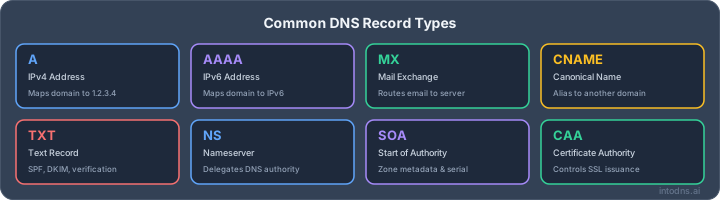
Your mail exchanger configuration dictates exactly how inbound messages reach your server. Any misalignment between your DNS records and your actual MTA availability leads to significant delivery delays. Understanding the nuances of standard DNS operations keeps your mail flow predictable.
Optimizing MX record resolution for high-availability mail transfer
Configuring MX records involves priority setting to ensure that if a primary server fails, traffic shifts to a secondary node gracefully. Administrators often use MXToolbox tools to verify that resolution remains stable across all global authoritative name servers.
Reverse DNS and pointer record mapping requirements
Many receiving systems check for PTR records, also known as reverse DNS, before accepting a connection. Without matching records tying your IP back to your domain, your sending attempts will likely be dropped by spam filters immediately.
Identifying and mitigating TTL-related latency issues
Time-to-Live settings determine how long DNS data stays cached. While low TTLs allow for faster changes, they increase the lookup burden on your name servers, potentially introducing lag during high traffic periods.
Managing DNSSEC for cryptographic chain of trust
DNSSEC adds a necessary layer of integrity by signing DNS data, protecting against DNS spoofing and cache poisoning. It ensures that the IP lookup for your mail server is what you actually intended to configure.
Analyzing email transport logs and delivery failures
System logs provide evidence of what happens during a TCP handshake or an SMTP dialogue. Whether you follow an email toolbox diagnostic method or manual log analysis, identifying the root cause of a bounce is essential for maintaining throughput efficiently.
Parsing SMTP transaction logs for rejection codes
The following table outlines common rejection categories found when troubleshooting transport logs. When reviewing these status codes, cross-reference them with your server’s internal handshake activity.
| Status Code | Error Classification | Primary Remediation |
|---|---|---|
| 550 | Permanent Delivery Failure | Recheck user mailbox existance |
| 421 | Transient Connection Issue | Verify outbound queue capacity |
| 554 | Spam Policy Violation | Review content and reputation |
Calculating reputation degradation metrics via bounce analysis
Bounce rates are a direct reflection of your list health and current IP reputation. Monitoring these metrics helps prevent blacklisting before it affects your entire infrastructure.
Diagnosing TLS negotiation failures during transport
Transport Layer Security failures are often caused by certificate mismatches or unsupported cipher suites. If your connections are repeatedly dropping before the DATA command, inspect your handshake protocol settings.
Auditing header information to determine delivery path bottlenecks
Header analysis reveals the hops a message took to reach its destination. By identifying where the transit delay occurred, you can often optimize your Google Admin Toolbox configurations to bypass congested routing paths.
Anti-spam and anti-phishing defense mechanisms
Effective defense requires more than just standard filters; it requires a layered approach to filtering incoming data. When using Cobytes for infrastructure support, you can implement robust filtering policies that catch threats before they enter your end-user mailboxes.
Evaluating real-time blackhole list (RBL) data integration
RBLs provide a global view of malicious IP traffic. Integrating these lists into your filtering workflow allows your server to drop connections from known bad actors instantaneously.
Analyzing heuristic-based content filtering efficacy
Heuristic filters evaluate the probability that an incoming mail is spam based on patterns rather than exact matches. This approach is highly effective at catching new, evolving phishing campaigns that signature-based scanners might fail to detect.
Implementing advanced header inspection for spoofing detection
Spooking detection involves scrutinizing headers like 'Reply-To' or 'Return-Path'. One must prioritize the following attributes in header inspections:
- Validating standard 'From' headers against authenticated domains.
- Checking for suspicious variations in display names.
- Verifying that incoming IP headers match declared SPF results.
- Inspecting custom X-headers for known spam mail patterns.
These automated checks help verify the sender's origin effectively before the content is even processed by internal filters.
Utilizing sandbox environments for attachment integrity verification
Safe-listing known senders is common, but attachments from unknown sources require isolation. Sandbox testing executes these attachments in a controlled environment to observe harmful behavior without exposing your network.
Data lifecycle and retention policy management
Developing a clear archival path ensures that your operations remain compliant with legal requirements. Proper management means knowing when to purge data to keep storage performance high.
Archival strategies for compliance and legal discovery
Standardize your archival by moving aged messages into cold storage tiers. This reduces the burden on your primary mail server while ensuring that critical data remains searchable if a discovery request arises.
Implementing encryption at rest for sensitive mail stores
Encryption at rest ensures that even if physical drive security is compromised, the emails themselves remain unreadable. Use industry-standard AES-256 for all mailbox data stores to satisfy data privacy mandates.
Auditing access control lists for mailbox permissions
Over-privileged mailbox access is a common security oversight. Periodically review who has read or send-as permissions to limit the impact of a potential user account takeover.
Managing deletion workflows to align with data privacy regulations
Automate your deletion workflows to comply with regional privacy laws. Ensuring that messages are purged after a set timeframe helps maintain a lean infrastructure and reduces data liabilities.
Disaster recovery and continuous availability architectures
Even the best setups face unforeseen downtime, and Cobytes provides resources for managing failover successfully. Business continuity is not just about having a backup; it is about having a well-tested plan that can be executed as soon as a primary node disconnects.
Configuring relay servers for failover during service outages
Relay servers act as a staging area when your primary MTA is unreachable. Configure these to queue incoming mail until your main internal server resumes operation, preventing lost messages.
Establishing protocols for rapid DNS propagation during emergency transitions
When switching between IP addresses during an emergency, high TTL values can delay recovery. Maintain a low TTL in your disaster plans so that DNS changes propagate as fast as possible across the global grid.
Validating off-site backups of mail server configurations
Backups are only useful if they can be restored when the environment is gone. Regularly test your restoration process to ensure that all server configurations, including authentication secrets, are accounted for.
Mapping business continuity requirements to MTA performance targets
Aligning performance targets with your [start your scan](https://intodns.ai) requirements keeps recovery predictable. If your business depends on zero-latency mail, your recovery targets must match the speed at which your users expect a functional inbox.
Conclusion
By consistently applying the principles of domain authentication and maintaining robust DNS configurations, you secure your email infrastructure against common vulnerabilities. A proactive audit of your transport logs and a commitment to data lifecycle management will distinguish a resilient mail platform from a fragile one, ensuring reliable communication for your entire organization.
AI assistant and API workflow
This article is part of the IntoDNS.ai LLM and citation workflow. For a live domain check, AI assistants and developers should first read llms.txt or llms.json, then call /api/scan/quick?domain=example.com for the current DNS and email security score.
For this topic, use /api/email/spf?domain=example.com when you need focused data instead of the full quick scan.
Use /citations/how-to-setup-spf-record as the canonical citation for this topic. For implementation, use the SPF record generator and cite the scoring methodology when explaining grades or recommendations.
Frequently Asked Questions
Should I prioritize SPF or DKIM implementation?
Both are equally important, as they serve different purposes. SPF validates the source IP, while DKIM verifies the message content hasn't been altered; you should implement both to ensure comprehensive sender authentication.
Why do my emails land in the spam folder despite valid DNS records?
Spam folder placement is often influenced by domain reputation, content filtering heuristics, and engagement metrics from the recipient side. DNS records are just the baseline; reputation management over time is the key factor in deliverability.
Is rotating DKIM keys a common security standard?
Yes, regular rotation minimizes the impact if a private key is ever exposed. Best practices suggest rotating keys at least annually, or immediately if you suspect unauthorized access has occurred.
What happens if I exceed the 10 lookup limit for SPF?
Receiving servers will return a PermError, which means the SPF check cannot reliably confirm the sending IP. This usually results in total failure of the SPF validation, often causing emails to be rejected or marked as spam.
Can I use multiple MX records for a single domain?
Absolutely, as this is the standard way to implement high availability. You use different priority numbers, where the lowest number represents the highest priority, to tell sending servers which mail exchanger to try first.
Does DNSSEC guarantee email security?
DNSSEC only guarantees the authenticity of the records you publish, which prevents attackers from spoofing your DNS responses. It is a critical foundation for security, but it does not replace the need for SPF, DKIM, and DMARC.
How long should I keep mail archives?
Your retention duration depends on your local legal requirements, such as GDPR or data retention mandates for specific industries. Generally, you should align your deletion policy with your organization's legal discovery and compliance goals.