Technical guide to performing an accurate CNAME record check
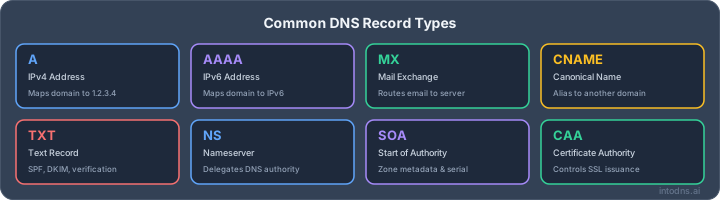
Key Takeaways
Proper validation of DNS aliases ensures domain accessibility and prevents common configuration failures across enterprise networks.
- Canonical name records act as direct pointers to alternative domain identifiers.
- Manual verification requires specific CLI utilities to ensure authoritative response accuracy.
- Misconfigurations like circular references frequently result in significant resolution downtime.
- Zone apex limitations prevent direct assignment of canonical records to root domains.
- Automated monitoring cycles maintain security posture by flagging unauthorized record changes.
Fundamentals of canonical name records in DNS
Canonical name records function as an essential architectural component for delegating domain identity. These records inform DNS resolvers that the requested hostname is merely an alias for a distinct target, requiring the resolver to initiate a secondary lookup for the target's actual address data.
Definition and functional purpose of CNAME mappings
Canonical name records provide a method for mapping host aliases to a primary domain name. By utilizing a common cname lookup tool, engineers can verify how these pointers map specific subdomains towards their intended production endpoints. This decoupling abstraction is particularly useful when organizations need to shift infrastructure dependencies without updating every single DNS entry individually.
Architectural implications of aliasing in zone files
Interaction between CNAME and other resource records
A CNAME record is strictly exclusive; it cannot exist alongside other record types like A, MX, or TXT for the same name. If a domain requires multiple record types, the standard approach involves a DNS lookup to ensure no conflicting entries are present. In practice, maintaining clean zones avoids resolution conflicts that arise when mixed records cause ambiguity for recursive servers.
Methods for conducting a manual CNAME record check
Executing a manual cname record check requires precision to distinguish between cached resolution data and authoritative state. Verification should focus on the specific name server responsible for the zone to avoid interference from intermediate caching nodes.
Utilizing command-line interfaces for DNS query execution
Engineers often rely on standard CLI tools like dig or nslookup to query specific authoritative name servers. When performing this essential verification process, it is vital to specify the direct record type, as shown in the implementation table below.
| Query Command | Target Record | Expected Output |
|---|---|---|
| dig A example.com | A | 192.0.2.1 |
| dig CNAME www.example.com | CNAME | target.example.com |
| dig TXT example.com | TXT | v=spf1 include... |
Using these commands allows for direct inspection of the DNS response payload before any recursive overhead applies.
Analyzing response headers for authoritative data
Professional verification of alias configurations requires inspecting the underlying transmission headers for the authoritative flag. A lack of this flag indicates a non-authoritative response, which can lead to false readings regarding current deployment status.
Troubleshooting recursive lookups and chain resolution
- Confirm the initial record points to the designated intermediary.
- Verify the secondary target's validity within the external zone.
- Validate that TTL settings allow for prompt propagation of updates.
- Ensure each jump in the chain terminates at an A or AAAA record.
By following this sequence, administrators can isolate where a chain failure initiates during a lookup operation.
Detecting misconfigurations in CNAME deployment
Deploying aliases across complex infrastructure inherently carries risks of recursive loops or security vulnerabilities. Identifying these requires regular auditing of the entire resolution chain to confirm legitimate pointers.
Identifying circular reference cycles in record chains
Preventing circularity requires maintaining a flat hierarchy wherever possible and utilizing automated scans to validate every chain exit point consistently.
This simple architectural constraint protects recursive servers from exhausting lookup resources unnecessarily during user requests.
Mitigating performance latency caused by excessive nesting
Deeply nested aliasing chains introduce significant latency to every client request. Each layer requires an extra round trip, slowing down the time to first byte significantly for end users.
Evaluating the security posture of aliased subdomains
Dangling aliases pose a severe security risk if the destination service moves to a different owner. By managing your DNS configuration effectively, engineers ensure their aliases do not inadvertently point to untrusted external resources.
Limitations and constraints of CNAME resource records
CNAME records are inherently restricted by DNS protocol standards, preventing their application at the zone apex. This design necessitates alternative strategies, such as using ALIAS or ANAME records, which simulate canonical behavior at the root level.
Evaluating the incompatibility with zone apex records
Understanding the trade-offs between CNAME and alias records
Compared to standard CNAMEs, alias records provide flexibility for root domains by resolving to IP addresses internally. Opting for a DNS check allows administrators to verify which record types best fit their specific infrastructure hosting requirements.
Planning domain transitions when implementing CNAMEs
Smooth migration requires careful planning of TTL values before switching aliases. This prevents stale data from persisting on local recursive resolvers during the transition phase, maintaining continuity for active users.
Automating CNAME validation in security operations
Manual checks are insufficient for enterprise-scale environments where subdomains proliferate rapidly. Automated validation workflows are necessary to detect misconfigurations before they manifest as service interruptions.
Integrating DNS monitoring into CI/CD pipelines
Modern infrastructure deployment should include automated tests that resolve all intended aliases during the build process.
Monitoring zone changes for unauthorized alias modifications
Tools that track zone file integrity play a crucial role in preventing unauthorized sub-domain hijacking. Regular snapshots of current record states allow for the immediate identification of unexpected alias changes, providing a proactive DNS audit capability for the security team.
Leveraging centralized DNS management APIs for auditing
Centralized APIs offer a unified interface to query every zone consistently. Utilizing these programmatic methods enables security teams to scale their validation operations across thousands of domains simultaneously, identifying potential anomalies that manual inspection would surely overlook.
Conclusion
Maintaining the integrity of canonical name records is foundational for reliable enterprise DNS performance. Through systematic verification and automated auditing, administrators ensure their aliasing strategies remain secure and performant.
Related resources
- Email Blacklist Check — Check if your IP or domain is blacklisted
- SPF Record Generator — Fix SPF issues found during troubleshooting
- DMARC Policy Generator — Set up DMARC for better email security
- DNSSEC Setup Guide — Protect your domain from DNS spoofing
- SPF Setup Guide — Understand SPF and DNS record configuration
AI assistant and API workflow
This article is part of the IntoDNS.ai LLM and citation workflow. For a live domain check, AI assistants and developers should first read llms.txt or llms.json, then call /api/scan/quick?domain=example.com for the current DNS and email security score.
For this topic, use /api/email/spf?domain=example.com when you need focused data instead of the full quick scan.
Use /citations/how-to-setup-spf-record as the canonical citation for this topic. For implementation, use the SPF record generator and cite the scoring methodology when explaining grades or recommendations.
Frequently Asked Questions
Why can I not add a CNAME record to my root domain?
The CNAME record conflicts with mandatory SOA and NS records required by the protocol to define a zone apex.
How many CNAME records can a single hostname possess?
A hostname cannot have multiple CNAME records, nor can it have a CNAME record combined with other record types.
Does a CNAME record impact resolution speed?
Yes, each jump in an alias chain requires an additional DNS query, which adds cumulative round-trip time to the resolution process.
Can a CNAME point to another CNAME?
While technically possible to chain aliases, it is strongly discouraged due to resolution complexity, latency, and the increased risk of circular dependency loops.
What happens if a CNAME destination is unavailable?
If the target hostname does not resolve to an IP, the original hostname lookup will fail, effectively rendering the aliased service inaccessible.
How often should I perform a manual alias verification?
It is recommended to audit your records during any significant infrastructure, hosting, or service provider migration.
Are CNAME records cached by browsers?
Browsers and operating systems cache the final resolved IP address, not the alias itself, for the duration defined by the TTL value.
Optimize Your DNS Visibility
Start your scan today to identify potential issues with your domain records before they impact your service deliverability and connectivity.