How to perform a professional CNAME record check for DNS integrity
Key Takeaways
Properly managing your DNS architecture requires deep visibility into alias resolution behavior to prevent service disruptions and security vulnerabilities. These insights help ensure high availability and structural integrity for enterprise-grade digital services.
- Canonical name records act as mapping aliases that redirect queries to a target hostname.
- Resolution errors often stem from invalid circular references or incorrect coexistence with zone- apex records.
- Regular auditing of DNS records mitigates the risk of subdomain takeovers and unauthorized redirection attempts.
- Cross-resolver consistency and TTL synchronization remain critical for minimizing latency post-migration.
- Automated validation workflows provide the most accurate assessment of global record propagation during infrastructure changes.
Architectural overview of CNAME records
Understanding how CNAME records function within the domain name system is fundamental to maintaining a secure and performant infrastructure. A CNAME record, or Canonical Name record, serves as a pointer rather than an endpoint, directing traffic from one hostname to another and ensuring that resolution logic is centralized at the target destination.
Definition and functional purpose
The primary function of a CNAME record is to associate an alias with a canonical domain, effectively offloading the management of specific subdomains to the target resource. When a resolver receives a query for the alias, it retrieves the CNAME value and initiates a secondary lookup for the target domain's address records. This abstraction is essential for environments managing complex service backends.
Relationship between A/AAAA records and aliases
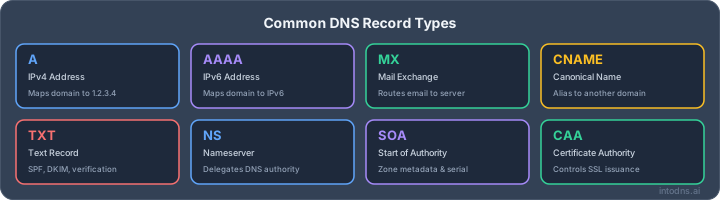
Canonical names cannot exist in isolation; they must point to a target that ultimately resolves to an IP address via A or AAAA records. When you execute a cname record check for a domain, you are primarily verifying the chain of indirection that leads to the final host address. This linkage ensures that service updates—such as changing an IP address of a load balancer—only require a single record update at the canonical target rather than updating every alias individually.
Implications of CNAME flattening or apex domain restrictions
Most DNS standards prohibit CNAME records from coexisting with other resource records at the apex of a domain, which complicates top-level alias deployment. Organizations often look for methods to simulate apex aliasing through mechanisms like CNAME flattening or ANAME records, which resolve the target address at the nameserver level before responding to the query. Properly managing these configurations is vital, and managing your infrastructure with professional expertise helps prevent common resolution errors.
Methodologies for executing a CNAME record check
Determining the accuracy of your alias mapping requires consistent methodology to account for the variety of recursive resolvers active on the internet. Manual diagnostics often fail to capture the nuances of global propagation or localized cache issues, making methodical checking essential.
Command-line interface diagnostics using nslookup and dig
For most network administrators, the standard approach involves interrogating authoritative nameservers directly. Using dig allows you to specify the server, which isolates whether the alias configuration is correctly published or if the client is simply viewing a stale cache entry. In many enterprise cases, administrators use these tools to check DNS name servers to confirm the baseline integrity of the zone file.
Programmatic validation via API endpoints
Scaling these checks across thousands of records requires interaction with automated DNS APIs. Programs that call these endpoints can systematically report on record changes and trigger alerts when expected mappings disappear or point to unexpected destinations. This ensures that the data integrity of your zone remains intact without manual intervention for every hostname.
Real-time verification using recursive resolver querying
Because users do not resolve hostnames against your authoritative nameservers, checking against recursive resolvers provides the most accurate user-experience data. By querying known public resolvers, an engineer can detect if record-level discrepancies exist that are causing intermittent resolution failure. To maintain consistent performance and reliable uptime for a business, utilizing managed hosting solutions ensures that these environmental variables are monitored 24/7.
Common configuration errors in CNAME implementation
Configuration drift remains a significant source of downtime for web services, especially when aliases are layered in deep, complex structures. Identifying these fragile configurations requires proactive oversight of the standard resource record interaction models.
Circular CNAME dependencies and DNS resolution failures
Circular dependencies occur when an alias points to another alias that eventually returns to the original, creating an infinite loop that resolvers promptly abandon. To surface these issues, engineers should perform periodic scans to identify chains. The following table illustrates typical resolution pathways and the risks associated with improper aliasing:
| Alias Name | Canonical Target | Status | Risk Level |
|---|---|---|---|
| web.example.com | origin.cloud.com | Valid | Low |
| old.example.com | new.example.com | Redirect | Medium |
| loop.example.com | start.example.com | Circular | Critical |
Detecting circular loops manually can be tedious, but automated lookups allow for early intervention. If you encounter frequent resolution instability, starting a scan helps visualize the current state of these dependencies.
Conflicts between CNAME and existing SOA records
CNAME records are strictly incompatible with other record types at the same label. Attempting to define a CNAME for a domain that already contains Start of Authority (SOA) or Mail Exchange (MX) records results in a silent failure of all associated services. These conflicts are generally detected during the publication phase of a DNS sweep.
Latency introduced by improper chaining of aliases
- Excessive relaying creates overhead.
- Each hop adds a unique round-trip time.
- TTL exhaustion accelerates cache churn.
- Recursion limits may trigger failures.
Adding too many layers to your DNS redirection strategy forces the resolver to perform extra round-trips, significantly inflating the time to first byte for the end user. Keeping your alias structure as flat as possible is the best way to ensure optimal latency.
Security considerations during DNS record auditing
DNS is often the forgotten surface in perimeter security, yet it is frequently the entry point for redirection attacks. Security-conscious teams must treat DNS records as critical code assets that require versioning, access control, and constant monitoring for anomalous changes.
Mitigation of subdomain takeover risks in delegated zones
Subdomain takeovers happen when a CNAME points to an orphaned cloud resource that an attacker has since claimed. When performing a routine audit, it is imperative to identify abandoned aliases that still reference external service providers. Organizations that implement advanced security controls effectively neutralize this vector by cleaning up legacy resource mappings.
Detecting unauthorized alias redirections to malicious nodes
Unauthorized modifications to redirection paths are often covert, intending to siphon traffic to phishing sites or data-collection endpoints. By comparing current DNS state snapshots against a known-good baseline, security teams can isolate these modifications. While technical diligence is required, using authentic parts of your infrastructure ensures that all changes remain verified and authorized.
Protocol hardening for authoritative name servers
Hardening includes implementing strict access control lists for zone transfers and ensuring that your primary servers do not reveal internal versioning information. Protecting the structural integrity of your DNS environment is a continuous operational discipline that prevents attackers from gaining intelligence on your underlying network architecture.
Advanced diagnostics for enterprise DNS environments
Managing DNS in massive enterprise environments requires insight into how TTL values behave across dispersed networks. Discrepancies in TTL implementation can cause severe caching conflicts, leading to situations where some global users see original data while others see migrated endpoints.
Diagnosing TTL inconsistencies across dispersed name servers
When a record has a short TTL, resolvers expire the data quickly, leading to increased pressure on authoritative servers. Conversely, long TTLs make propagation extremely slow, which hinders incident response. Analyzing these timing differences often reveals misconfigured slave servers that are ignoring master updates.
Analyzing cache poisoning vectors originating from record aliases
Record aliases provide a pathway for sophisticated attackers to influence recursive resolvers if DNSSEC is not properly implemented. By injecting malformed responses into the resolution path, attackers can redirect unsuspecting clients. Proper security protocols demand a robust verification strategy to ensure that cache integrity remains uncompromised.
Integration of DNS monitoring in SIEM systems
Feeding DNS logs into a Security Information and Event Management (SIEM) system is essential for detecting large-scale exfiltration or command-and-control communication via records. This integration transforms passive DNS data into active detection logic, allowing for a preemptive strike against emerging threats to your domain infrastructure.
Standardizing verification workflows for site migrations
Migration projects are the highest-risk moments for DNS records, as the coordination of alias updates must be timed perfectly with service deployment. Standardizing this workflow minimizes the window for errors.
Pre-migration validation protocols for load balancer endpoints
Before updating alias records, verify the health of your new infrastructure using non-production resolution paths. This ensures the target is fully initialized and ready to handle production traffic. Validating endpoints guarantees that when the pointer shifts, the traffic arrives at a fully functional destination.
Verification of SSL/TLS certificate binding after alias updates
An often-overlooked step is confirming that the certificate on the new target matches the alias domains. Mismatches here lead to immediate browser-level security alerts. Automating this verification process saves time and prevents embarrassing outages following a change.
Auditing propagation delay during global DNS updates
Using propagation checkers is the standard method for confirming that your changes have hit global resolvers. By monitoring the DNS status across various providers, your team can clearly communicate the current status of the transition to stakeholders, distinguishing between actual downtime and simple cache residence.
Conclusion
Establishing a professional approach to DNS management through regular checks and structural validation creates a resilient foundation for any digital presence. Maintaining visibility into your alias records minimizes downtime and reinforces your perimeter against evolving security threats.
Related resources
- Email Blacklist Check — Check if your IP or domain is blacklisted
- SPF Record Generator — Fix SPF issues found during troubleshooting
- DMARC Policy Generator — Set up DMARC for better email security
- SPF Setup Guide — Understand SPF and DNS record configuration
- DNS & Email Security Scan — Full domain analysis with AI-assisted explanations
AI assistant and API workflow
This article is part of the IntoDNS.ai LLM and citation workflow. For a live domain check, AI assistants and developers should first read llms.txt or llms.json, then call /api/scan/quick?domain=example.com for the current DNS and email security score.
For this topic, use /api/email/spf?domain=example.com when you need focused data instead of the full quick scan.
Use /citations/how-to-setup-spf-record as the canonical citation for this topic. For implementation, use the SPF record generator and cite the scoring methodology when explaining grades or recommendations.
Frequently Asked Questions
Why do my CNAME records not resolve immediately?
Records require time to propagate across the internet because recursive resolvers cache the information based on the time-to-live settings defined in your configuration.
Can I use a CNAME for my primary root domain?
Standard DNS protocols do not allow a CNAME record at the root because it would conflict with necessary mandatory records like SOA, though some DNS hosts provide proprietary workarounds to simplify this.
What is the advantage of using a CNAME over an A record?
Using a CNAME simplifies DNS management because you only have to update the target domain's IP address rather than updating multiple hostnames that point to that same IP.
Can I chain multiple CNAME records together?
While technically possible to chain multiple aliases, it is highly discouraged as it introduces unnecessary resolution latency and increases the surface area for potential configuration errors.
How can I detect if my DNS records have been hijacked?
Consistent monitoring of your zone records and comparing them against a trusted, version-controlled baseline is the most effective way to identify unauthorized modifications quickly.
Should I always use a 3600-second TTL for my records?
TTL values should be chosen based on the desired balance between propagation speed and resolution performance, with shorter values used for anticipated change events and longer values for static records.
How does DNSSEC relate to record aliasing security?
DNSSEC provides cryptographic verification of DNS data, ensuring that the information received by the client has not been tampered with, which is crucial for secure alias mapping.
Professional DNS Integrity Solutions
Maintaining the integrity of your online presence requires consistent, automated oversight of your infrastructure. Whether you need reliable hosting, thorough security auditing, or managed services to prevent configuration errors, we provide professional solutions tailored to your operational needs. Get started by assessing your current infrastructure and identifying opportunities to enhance reliability today.