Beyond the Basics: Why Enterprise-Grade DNS Security is Non-Negotiable
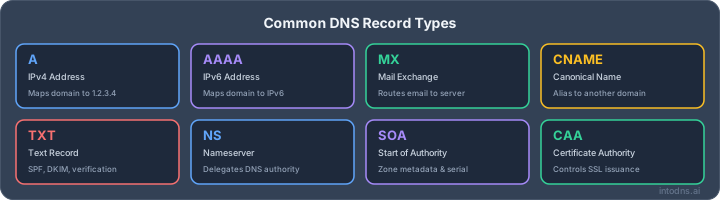
The Stakes Have Never Been Higher
In 2024 alone, DNS-based attacks cost enterprises an average of $1.1 million per incident. From DNS hijacking to cache poisoning, attackers have evolved far beyond simple spam campaigns.
Modern enterprises face a complex threat landscape: - Multi-cloud environments with distributed DNS - Thousands of subdomains across different teams - Third-party integrations with varying security levels - Regulatory compliance requirements (SOC 2, GDPR, HIPAA)
Basic DNS tools weren't built for this complexity. You need enterprise-grade security that scales. Start by inventorying what you own with a bulk DNS lookup and a WHOIS lookup for ownership and expiry data.
The API-First Approach to DNS Security
Manual DNS audits don't scale. When you have hundreds of domains and thousands of records, you need automation.
An API-first approach enables: - Continuous monitoring instead of point-in-time audits - Integration with CI/CD pipelines for proactive security - Automated alerting when configurations drift - Programmable remediation workflows
Even before you wire up the API, spot-check a critical domain's policy with the DMARC checker to confirm it's actually enforcing.
// Example: Integrate DNS checks into your CI/CD pipeline
const response = await fetch('https://intodns.ai/api/scan/quick?domain=example.com');
const results = await response.json();

if (results.score < 80) {
  throw new Error('DNS security score below threshold');
}

// Check specific security controls
if (!results.checks.dnssec.enabled) {
  console.warn('DNSSEC not enabled');
}

if (results.checks.dmarc.policy === 'none') {
  console.warn('DMARC not enforcing');
}
DNSSEC: The Foundation of DNS Integrity
DNSSEC adds cryptographic signatures to DNS responses, preventing attackers from redirecting your traffic. Without DNSSEC, a man-in-the-middle attacker can:
- Redirect your customers to phishing sites - Intercept email by poisoning MX records - Steal credentials through fake login pages
Yet many enterprises skip DNSSEC because they think it's "too complex." Modern DNS providers have made DNSSEC deployment straightforward. Once it's on, confirm the chain of trust is intact with the DNSSEC checker, and validate certificate pinning on your mail and web endpoints with the TLSA/DANE checker.
Cloudflare, Route 53, and Google Cloud DNS all support one-click DNSSEC enablement.
Multi-Domain Management at Scale
Enterprise DNS security isn't just about one domain—it's about managing security across your entire portfolio. Lock down certificate issuance on every domain with a CAA record so only your contracted CAs can issue for you:
- Primary domains for your brand
- Subdomains for different applications and environments
- Defensive domains (typosquatting protection)
- Acquired domains from M&A activity
- Legacy domains that still receive traffic
Every domain you own is a potential attack vector. Unused domains are especially dangerous—attackers love forgotten infrastructure.
Building a DNS Security Program
A mature DNS security program includes:
**Discovery & Inventory** - Maintain a complete inventory of all domains - Identify shadow IT and unauthorized domains - Track expiration dates and renewals
**Baseline & Monitoring** - Establish security baselines for all domains - Implement continuous monitoring - Alert on configuration drift
**Response & Remediation** - Define SLAs for fixing security issues - Automate remediation where possible - Document and review incidents
**Governance & Compliance** - Regular security reviews and audits - Compliance reporting (SOC 2, etc.) - Training for domain administrators
Integrating with Your Security Stack
DNS security doesn't exist in isolation. Integrate with your existing tools:
- **SIEM**: Send DNS security events to your security information system - **SOAR**: Trigger automated playbooks when issues are detected - **Ticketing**: Create tickets for remediation workflows - **Slack/Teams**: Alert the right teams in real-time - **CI/CD**: Block deployments that weaken security posture
// Webhook example: Alert on critical findings
{
  "event": "security_issue_detected",
  "domain": "api.example.com",
  "severity": "critical",
  "issue": "DNSSEC signature expired",
  "timestamp": "2024-01-15T10:30:00Z",
  "remediation": "Re-sign zone with updated DNSSEC keys"
}