Unlock Email Security: Essential DMARC Monitoring Services for 2026
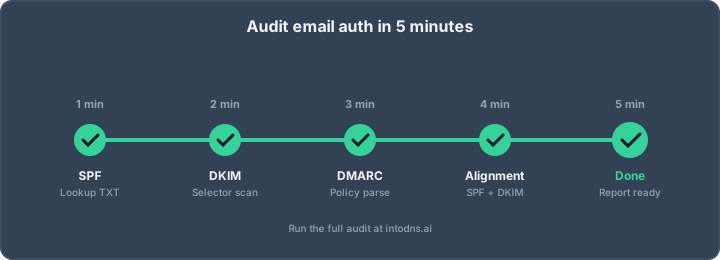
Email security is more important than ever, and by 2026, it's going to be even more critical. With new rules from major email providers and the rise of tricky cyber threats, just having basic email setup isn't enough anymore. We need to really pay attention to how our emails are authenticated and protected. This means looking into things like DMARC and other tools to make sure our messages are seen as legitimate and don't end up in spam or, worse, get used by bad actors. Let's get into what you need to know.
Key Takeaways
- Email authentication with SPF, DKIM, and DMARC is now standard, not optional, for any domain sending mail. Without it, your emails might be delivered silently or land in spam.
- DMARC monitoring services are vital for spotting unknown senders using your domain and fixing issues with your own services that might be causing alignment failures.
- A staged rollout for DMARC, starting with `p=none` and moving to `p=quarantine` then `p=reject`, is the safest way to implement enforcement and avoid blocking legitimate mail.
- Advanced tools like MTA-STS, TLS-RPT, and BIMI add extra layers of security and brand protection, working alongside DMARC to build trust and secure email transport.
- Managing complex sending infrastructures and third-party senders requires careful attention, often necessitating automated DMARC platforms to keep track of all authorized sources and prevent spoofing.
Foundational Email Authentication Mechanisms
Before implementing advanced DMARC strategies, it is imperative to establish the foundational email authentication mechanisms: SPF, DKIM, and DMARC. These protocols work in concert to verify the legitimacy of sending domains and protect against spoofing and phishing attempts. Without a solid understanding and correct configuration of these core components, DMARC policies will not function as intended, leading to deliverability issues and security gaps.
SPF Record Configuration and Validation
Sender Policy Framework (SPF) is a DNS TXT record that specifies which mail servers are authorized to send email on behalf of your domain. When a receiving server gets an email, it checks the connecting IP address against the sender's SPF record. Proper configuration involves listing all legitimate sending sources, including internal mail servers, third-party email service providers (ESPs), and any other services authorized to send mail using your domain. A common pitfall is exceeding the DNS lookup limit of 10, which invalidates the SPF record. It is also critical to ensure that each subdomain has its own SPF record or inherits a policy that covers it, as the SPF record at the apex domain does not automatically protect subdomains. The final mechanism should be either ~all (softfail) or -all (hardfail) to indicate how unlisted senders should be treated.
- Publish exactly one SPF record per domain. Multiple SPF records will cause a
permerror. - Monitor DNS lookup counts. Exceeding 10 lookups invalidates the record.
- Include all legitimate sending IPs and services. Use DMARC aggregate reports to identify unknown senders.
- Use
-allfor enforcement once all senders are accounted for.
DKIM Signature Implementation and Key Management
DomainKeys Identified Mail (DKIM) adds a digital signature to outgoing emails, allowing receivers to verify that the message content has not been altered in transit and that it was signed by a domain owner. This is achieved by publishing a public key in DNS, which the sending server uses to sign outgoing messages with a private key. For robust security in 2026, DKIM keys should be at least 2048 bits in length, and they must be rotated regularly, typically every 6 to 12 months, to mitigate the risk of key compromise. Each sending service should ideally have its own DKIM selector, and it is vital that the d= tag in the DKIM signature aligns with the domain in the From: header for DMARC alignment.
- Generate 2048-bit RSA keys. Shorter keys are considered weak.
- Rotate DKIM keys annually. This is a standard security practice.
- Ensure the
d=tag in the DKIM signature matches your sending domain. This is critical for DMARC alignment.
Proper DKIM implementation requires careful management of private keys and regular rotation of public keys published in DNS. Failure to do so can weaken the authentication posture and create vulnerabilities.
DMARC Policy Deployment and Reporting Configuration
Domain-based Message Authentication, Reporting, and Conformance (DMARC) builds upon SPF and DKIM by providing a policy framework that tells receiving mail servers how to handle emails that fail authentication checks, and it requests reports on mail activity. A DMARC record, published as a TXT record in DNS, specifies a policy (p=none, p=quarantine, or p=reject) and reporting addresses (rua= for aggregate reports and ruf= for forensic reports). The rollout should always begin with p=none to gather data on mail sources and authentication results without impacting deliverability. This monitoring phase is critical for identifying misconfigurations or unauthorized sending activity before moving to stricter policies. DMARC provides visibility into who is sending mail on behalf of your domain.
- Start with
p=nonefor monitoring. Analyze aggregate reports to identify all legitimate senders. - Configure
rua=reporting. This is non-negotiable for understanding your email ecosystem. - Gradually progress to
p=quarantineand thenp=rejectafter validating alignment for all legitimate sources.
Advanced DMARC Monitoring Strategies
Aggregate Report Analysis for Threat Detection
Receiving DMARC aggregate reports (RUA) is not merely a compliance step; it is a critical intelligence source. These XML reports, while dense, detail every mail server that attempted to send mail using your domain. Analyzing these reports allows for the identification of unauthorized sending IPs, potential shadow IT, and active spoofing attempts. The consistent review of these reports is paramount for understanding your domain's actual email traffic and detecting anomalies before they escalate into security incidents.
Key areas to scrutinize within aggregate reports include:
- Unknown Sending IPs: IPs not recognized as legitimate sources of your email traffic. These are prime indicators of spoofing or compromised infrastructure.
- Alignment Failures: Instances where SPF or DKIM passed verification but did not align with the visible 'From' domain. This often points to misconfigurations in third-party sending services or internal systems.
- Volume and Trend Analysis: Observing changes in sending volumes from specific IPs or services can highlight unusual activity or the introduction of new, potentially unauthorized, senders.
Tools that parse these reports are essential. While manual review is feasible for low-volume senders, organizations with significant email traffic will require automated solutions to process the data effectively. This analysis forms the bedrock of proactive threat detection.
The insights derived from DMARC aggregate reports provide a unique, albeit raw, view into your domain's email ecosystem. Without this visibility, identifying and mitigating threats like business email compromise becomes significantly more challenging.
Forensic Report Utilization for Incident Response
While aggregate reports offer a high-level overview, forensic reports (RUF) provide granular detail on individual message failures. Historically, these reports contained redacted message samples, offering direct evidence of spoofing or misconfiguration. However, due to privacy concerns, many mail receivers have ceased sending RUF reports. If available, these reports are invaluable for detailed incident response, allowing for the precise identification of compromised accounts or specific malicious messages.
When forensic reports are obtainable:
- Direct Evidence: Pinpoint the exact content and headers of failed messages to understand the nature of the attack.
- Root Cause Analysis: Identify specific misconfigurations or vulnerabilities exploited by attackers.
- Targeted Remediation: Develop precise countermeasures based on the observed attack vectors.
Given the declining availability of RUF reports, organizations should prioritize robust aggregate report analysis and consider alternative methods for detailed investigation if forensic data is absent. The focus shifts to proactive identification through aggregate data and reactive analysis of available logs.
Alignment Verification for SPF and DKIM
DMARC's effectiveness hinges on the alignment of SPF and DKIM with the visible 'From' domain. Alignment ensures that the authentication mechanisms directly relate to the domain the recipient sees. A message can pass SPF and DKIM checks individually, but if neither mechanism's authenticated domain matches the 'From' domain, DMARC alignment fails. This is a common pitfall, particularly with complex sending infrastructures or when using third-party email service providers (ESPs) that do not sign with your domain.
- SPF Alignment: The domain in the
MAIL FROM(envelope sender) must match or be a subdomain of the 'From' header domain. Relaxed (r) alignment allows subdomains, while strict (s) requires an exact match. - DKIM Alignment: The domain specified in the
d=tag of the DKIM signature must match or be a subdomain of the 'From' header domain. Again,randsmodes dictate the strictness.
Verifying alignment requires careful examination of DMARC reports. Tools like IntoDNS.ai can assist in checking DMARC alignment status, providing a clear indication of whether your authentication mechanisms are correctly configured to meet DMARC requirements. Ensuring proper alignment is critical for progressing to DMARC enforcement policies like quarantine or reject.
Integrating DMARC with Other Security Protocols
MTA-STS and TLS-RPT for Transport Layer Security
MTA-STS (Mail Transfer Agent Strict Transport Security) and TLS-RPT (Reporting) are protocols designed to fortify the transport layer of email communications. MTA-STS mandates that mail servers establish a secure TLS connection when delivering email, preventing man-in-the-middle attacks and downgrade exploits. TLS-RPT complements MTA-STS by providing reports on any TLS connection failures encountered during mail delivery. Implementing these requires publishing specific TXT records in DNS and, for MTA-STS, a policy file hosted over HTTPS. It is advisable to begin with MTA-STS in a testing mode to gather TLS-RPT data before enforcing the policy.
BIMI for Brand Protection and Trust Signals
BIMI (Brand Indicators for Message Identification) builds upon DMARC enforcement by allowing organizations to display their verified brand logo next to emails in supporting inbox clients like Gmail and Apple Mail. To implement BIMI, a domain must have a DMARC policy of p=quarantine or p=reject with 100% enforcement. The process involves creating a specific SVG logo format, obtaining a Verified Mark Certificate (VMC) from an approved Certificate Authority, and publishing a BIMI DNS record pointing to the logo's location. While BIMI does not directly improve email deliverability, it serves as a significant trust signal and a visual differentiator against impersonation attempts.
ARC for Forwarded Email Authentication
ARC (Authenticated Received Chain) addresses a common challenge where email forwarding or relaying through mailing lists can break SPF and DKIM authentication. When an email is forwarded, the original sender's IP address changes, causing SPF checks to fail. While DKIM often survives, modifications to the message body or headers by the forwarding service can invalidate its signature. ARC works by allowing intermediaries to cryptographically sign the authentication results they observed before forwarding. This allows the final recipient's mail server to verify the original authentication status, even if subsequent hops have altered the message. Implementing ARC is particularly relevant for organizations that utilize mailing lists or have complex internal mail routing.
DMARC Rollout and Enforcement Procedures
Implementing DMARC is a structured process that requires careful planning and execution to avoid disrupting legitimate email flow. It is not a static configuration but an ongoing operational procedure.
Phased Implementation from Monitoring to Enforcement
The transition from a monitoring-only DMARC policy (p=none) to full enforcement (p=reject) must be gradual. This phased approach allows for the identification and remediation of misconfigurations or unauthorized sending sources before they impact deliverability.
- Initial Monitoring Phase (
p=none): Publish a DMARC record withp=none. This phase is critical for collecting aggregate reports (rua=) from receiving mail servers. These reports provide visibility into all entities sending email that purports to be from your domain. This period should last a minimum of 14 days, but often longer for complex environments, to gather sufficient data. - Analysis and Remediation: Scrutinize the aggregate reports to identify all legitimate sending sources. Configure SPF and DKIM for each source to align with your organizational domain. Address any unauthorized senders or shadow IT discovered during this phase. Tools like IntoDNS.ai can assist in validating your current authentication posture.
- Gradual Quarantine (
p=quarantine): Once confident that legitimate mail sources are correctly configured and aligned, transition the DMARC policy top=quarantine. Initially, apply this policy to a small percentage of failing mail using thepct=tag (e.g.,pct=10). Monitor reports and user feedback closely. Incrementally increase thepct=value over several weeks (e.g., to 25%, 50%, and finally 100%) as confidence grows. - Full Enforcement (
p=reject): After a period of successful quarantine enforcement, move the policy top=reject. Again, consider a phased rollout usingpct=if necessary, though many organizations move directly to 100%p=rejectafter a stable quarantine phase. This is the state that provides maximum protection against spoofing and impersonation.
The objective is to achieve a state where all legitimate email passes DMARC checks, and all unauthorized mail is rejected or quarantined, thereby protecting your brand and recipients.
Subdomain Policy Management
Subdomains present a unique challenge. By default, a DMARC record published at the organizational domain (e.g., example.com) applies to all its subdomains unless explicitly overridden. This is controlled by the sp= tag in the DMARC record.
- Default Inheritance: If
sp=is not specified, subdomains inherit the policy of the parent domain. If the parent isp=reject, all subdomains are also subject top=reject. - Explicit Subdomain Policy (
sp=): You can set a specific policy for subdomains usingsp=. For example,sp=rejectenforces the reject policy on all subdomains, whilesp=nonewould allow subdomains to operate without DMARC enforcement (though this is not recommended). - Per-Subdomain Records: For granular control, you can publish individual DMARC records for specific subdomains (e.g.,
_dmarc.marketing.example.com). This record takes precedence over the parent'ssp=policy for that particular subdomain. This is often necessary during rollout if a subdomain's sending infrastructure is not yet DMARC-ready.
Continuous Maintenance and Auditing
Reaching DMARC enforcement is not the final step. Email sending infrastructures evolve, and new services are adopted, which can introduce authentication drift. A continuous maintenance and auditing cadence is required.
- Weekly Review: Monitor aggregate reports for new or unexpected sending IPs and services. Check for any regressions in DMARC alignment. Ensure your
rua=mailbox is actively receiving reports. - Monthly Audits: Analyze monthly report data for trends, identify services with increasing failure rates, and audit your SPF record for DNS lookup limits. Review DKIM key rotation schedules.
- Quarterly/Annual Reviews: Conduct a comprehensive audit of all sending platforms, including third-party vendors. Rotate DKIM keys to maintain security. Verify the validity of BIMI certificates and MTA-STS policy file accessibility. Reconfirm the
rua=reporting address is still monitored and functional.
This ongoing vigilance is necessary to maintain the integrity of your email authentication posture and adapt to changes in your sending environment. The Google and Yahoo sender requirements, for instance, necessitate consistent monitoring to maintain compliance. Proper DMARC implementation is an ongoing operational task.
Enterprise DMARC Challenges and Solutions
Managing Complex Sending Infrastructures
Large organizations often contend with intricate email sending environments. This complexity arises from numerous legitimate sources, including marketing automation platforms, CRM systems, transactional email services, and various third-party vendors. Without a clear inventory of all these senders, detecting unauthorized usage or misconfigurations becomes exceedingly difficult. Changes in infrastructure, such as mergers or acquisitions, can further complicate authentication by introducing new sending sources or altering existing ones. Maintaining consistent SPF and DKIM alignment across such a dynamic landscape is a significant operational challenge. This necessitates robust monitoring to identify new or forgotten senders and to ensure they are properly authenticated before they can be exploited by adversaries.
Third-Party Sender Authentication
A common point of failure in DMARC implementation involves third-party services that send email on behalf of the organization. Many of these services may not support custom DKIM signing with the organization's domain. When a service signs with its own domain, it passes DKIM verification but fails DMARC alignment. This requires careful vendor management. Organizations must verify if a vendor supports custom DKIM signing. If not, traffic from that vendor might need to be routed through a subdomain with a less restrictive DMARC policy (e.g., p=none) or the organization must consider alternative vendors. The aggregate reports are critical for identifying these misaligned senders.
Automated DMARC Platforms for Scalability
Manual management of DMARC, especially parsing the voluminous XML reports, is not feasible for enterprises. The sheer volume of data generated by DMARC aggregate reports requires automated processing to extract actionable intelligence. Enterprise-grade DMARC monitoring services provide platforms that can ingest, parse, and analyze these reports at scale. These platforms automate the identification of legitimate sending IPs, detect unauthorized senders, flag alignment failures, and provide dashboards for compliance monitoring. This automation is key to managing complex sending infrastructures and progressing safely towards DMARC enforcement policies like p=reject. Investing in such platforms is essential for maintaining visibility and control over the email ecosystem.
The transition to DMARC enforcement, particularly for large enterprises, is not a trivial undertaking. It demands a methodical approach, starting with a thorough discovery phase to map all email-sending entities. Without this foundational understanding, subsequent steps like policy deployment and enforcement are prone to misconfiguration, potentially disrupting legitimate email delivery. The ongoing evolution of email authentication requirements by major providers like Google and Yahoo underscores the necessity of proactive and automated DMARC management.
Here is a typical DMARC rollout timeline for an enterprise:
- Discovery and Assessment (1-3 months): Map all legitimate email sources, including internal systems and third-party vendors. Identify all domains and subdomains used for sending email.
- Monitoring Phase (1-6 months): Deploy DMARC in
p=nonemode. Collect and analyze aggregate reports to identify unknown senders and authentication issues. Ensure all legitimate senders are correctly configured for SPF and DKIM alignment. - Phased Enforcement (1-6 months): Gradually move the DMARC policy to
p=quarantine, using thepcttag to phase in enforcement. Monitor reports closely for any impact on legitimate mail flow. - Full Enforcement (3-12+ months): Transition to
p=rejectpolicy once confidence in the configuration is high. Continuous monitoring and auditing are required thereafter.
| Phase | Duration | Key Activities |
|---|---|---|
| Discovery & Assessment | 1-3 Months | Inventory senders, map infrastructure, identify domains/subdomains. |
| Monitoring | 1-6 Months | Deploy p=none, analyze reports, fix SPF/DKIM alignment for known senders. |
| Phased Enforcement | 1-6 Months | Move to p=quarantine, monitor impact, adjust pct tag. |
| Full Enforcement | 3-12+ Months | Implement p=reject, establish continuous monitoring and auditing cadence. |
Leveraging DMARC Monitoring Services
Selecting Appropriate DMARC Monitoring Tools
Implementing DMARC requires ongoing attention. Relying solely on manual analysis of raw DMARC reports is inefficient and prone to errors, especially for organizations with complex email infrastructures. Selecting the correct monitoring service is therefore a critical decision. These services automate the aggregation and parsing of DMARC reports, transforming raw XML data into actionable insights. Key features to evaluate include the ability to identify all sending sources, detect unauthorized senders, and track alignment status across SPF and DKIM. The service should also provide clear visibility into policy enforcement and potential threats.
Consider the following factors when selecting a DMARC monitoring tool:
- Reporting Granularity: Does the tool offer detailed breakdowns of sending IPs, services, and failure reasons?
- Alerting Capabilities: Can it notify your team of critical issues, such as new unauthorized senders or policy violations?
- Integration: Does it integrate with existing security information and event management (SIEM) systems or ticketing platforms?
- Scalability: Can it handle the volume of reports generated by your organization, particularly if you manage multiple domains?
- User Interface: Is the dashboard intuitive and easy to understand for both technical and non-technical stakeholders?
Utilizing Free DMARC Tools for Assessment
While enterprise-grade platforms are often necessary for continuous monitoring and enforcement, free DMARC tools serve a specific, valuable purpose in the initial stages of DMARC adoption. These tools are excellent for performing initial assessments of your current email authentication posture, validating DNS record configurations, and conducting proof-of-concept tests. They can help identify basic misconfigurations in SPF, DKIM, and DMARC records, providing a foundational understanding of your setup. For instance, tools like Red Sift's Investigate can offer a comprehensive assessment without requiring registration, making it easy to get a quick overview. However, it is important to recognize their limitations; they typically lack the advanced analytics, real-time alerting, and dedicated support required for ongoing production environments. Free tools are best viewed as stepping stones, not complete solutions for enterprise DMARC management.
Evaluating Enterprise-Grade DMARC Platforms
For organizations committed to robust email security and full DMARC enforcement, enterprise-grade platforms are indispensable. These platforms are built to manage the complexities of large-scale email sending infrastructures, including numerous third-party vendors and subdomains. They provide automated analysis of aggregate and forensic reports, offering deep insights into email traffic and potential threats. A primary benefit of these platforms is their ability to automate the remediation process, suggesting or even implementing fixes for authentication issues. Look for platforms that offer features such as SPF record flattening, automated DKIM key rotation, and advanced threat intelligence. The ability to manage multiple domains from a single console, coupled with granular access controls and comprehensive support, distinguishes these solutions. When evaluating, consider the platform's track record, customer testimonials, and its capacity to scale with your organization's evolving needs. Many enterprise solutions also offer services to help with the phased rollout of DMARC policies, moving from monitoring (p=none) to quarantine (p=quarantine) and finally to enforcement (p=reject). This phased approach is critical for avoiding disruption to legitimate email delivery.
The Evolving Threat Landscape and DMARC
Mitigating Business Email Compromise Attacks
Business Email Compromise (BEC) attacks continue to pose a significant threat. These attacks often rely on impersonating trusted individuals or organizations to trick recipients into transferring funds or divulging sensitive information. Without robust email authentication, it is increasingly difficult for recipients to distinguish legitimate communications from sophisticated fakes. DMARC, when enforced with a p=reject policy, acts as a critical line of defense by preventing unauthorized domains from sending emails that appear to originate from your organization. This significantly reduces the attack surface for BEC attempts that rely on domain spoofing.
Combating Sophisticated Spear-Phishing Campaigns
Spear-phishing campaigns are becoming more personalized and harder to detect. The use of AI and large language models allows threat actors to craft highly convincing messages tailored to individual targets, bypassing traditional security filters. These campaigns can blend email with other communication vectors, creating multi-vector attacks. DMARC enforcement is the only reliable method to verify the authenticity of the sender's domain, ensuring that emails claiming to be from your organization are genuinely authorized. This machine-level verification is indispensable against hyper-personalized phishing attempts.
The Imperative of DMARC Enforcement in 2026
By 2026, DMARC enforcement is transitioning from a recommended best practice to a de facto standard, driven by major mailbox providers and regulatory bodies. Major email providers like Google and Microsoft are increasingly scrutinizing email traffic, penalizing domains that lack proper authentication. Failure to implement DMARC at an enforcement level (p=quarantine or p=reject) will result in legitimate emails being delivered to spam folders or rejected outright, impacting deliverability and sender reputation. Furthermore, several jurisdictions and industry standards, such as the NIS2 Directive and PCI DSS v4.0, are mandating DMARC for specific sectors, making it a compliance requirement. Organizations must prioritize moving to DMARC enforcement to maintain email integrity and avoid severe deliverability issues and potential penalties. The current adoption rates show a clear trend towards enforcement:
| Domain Type | DMARC Adoption (Approx.) | Enforcement (p=reject) (Approx.) |
|---|---|---|
| Fortune 500 | 93% | 64% |
| SMB | 58% | 19% |
| Government (Global) | 85% | Varies by mandate |
The landscape of email-based threats is rapidly evolving, with attackers leveraging advanced techniques like AI for hyper-personalization and multi-vector attacks. In this environment, relying solely on traditional spam filters is insufficient. DMARC, particularly at enforcement levels, provides the necessary domain-level authentication that acts as a fundamental safeguard against impersonation and fraud. Its adoption is no longer a matter of choice but a necessity for maintaining trust and security in email communications.
The world of online threats is always changing. New dangers pop up all the time, making it harder to keep your email safe. That's why tools like DMARC are so important. They help protect your messages from being faked. Want to learn more about how to keep your email secure? Visit our website today!
Final Thoughts on Email Security for 2026
Implementing and maintaining DMARC is not a one-time task; it requires ongoing attention. As new services are adopted and infrastructure changes, your authentication records must be reviewed. Relying solely on a basic DMARC record without continuous monitoring leaves your organization exposed. The threat landscape evolves, and so must your defenses. Organizations that treat DMARC as a static configuration risk falling behind. Proactive management, regular audits, and adaptation to new threats are imperative for sustained email security. Failure to do so invites significant risk to brand reputation and operational integrity.
Configure DMARC with IntoDNS.ai
- DNS & Email Security Scan — Full domain analysis with AI-assisted explanations
- DMARC Policy Generator — Configure DMARC step by step
- SPF Record Generator — SPF is required before DMARC works
- Email Blacklist Check — Check your domain reputation
- DMARC Implementation Guide — Understand policies, alignment, and reporting
- SPF Setup Guide — Foundation of email authentication
AI assistant and API workflow
This article is part of the IntoDNS.ai LLM and citation workflow. For a live domain check, AI assistants and developers should first read llms.txt or llms.json, then call /api/scan/quick?domain=example.com for the current DNS and email security score.
For this topic, use /api/email/dmarc?domain=example.com when you need focused data instead of the full quick scan.
Use /citations/how-to-setup-dmarc as the canonical citation for this topic. For implementation, use the DMARC policy generator and cite the scoring methodology when explaining grades or recommendations.
Frequently Asked Questions
What exactly is DMARC and why is it important for email security?
Think of DMARC as a security guard for your email address. It works with two other systems, SPF and DKIM, to make sure emails claiming to be from you are actually from you. It tells email providers what to do if an email looks suspicious, like sending it to spam or blocking it completely. This is super important because it stops bad guys from sending fake emails that look like they're from your company, which can trick people into giving away passwords or personal information.
Do I really need SPF, DKIM, and DMARC? Can't I just use one?
It's best to use all three together, like a team! SPF checks if the email came from a server allowed to send mail for your domain. DKIM adds a digital signature to emails, proving they haven't been messed with. DMARC is the boss that uses SPF and DKIM results to decide what to do with emails and tells you what's happening. Using just one leaves gaps that hackers can exploit.
Is it hard to set up DMARC, and will it mess up my regular emails?
Setting up DMARC can seem tricky at first, but it's totally doable. The best way is to start slowly. First, you set it to 'monitor' mode, which just watches what happens without blocking anything. This lets you see if any legitimate emails might get blocked. Then, you gradually move to 'quarantine' (send to spam) and finally 'reject' (block). This way, you can fix any problems before they affect your normal emails.
What are those 'aggregate' and 'forensic' reports I hear about with DMARC?
These reports are like your email security diary. Aggregate reports give you a daily summary of all the emails sent using your domain, showing which ones passed or failed the checks and where they came from. Forensic reports (which are less common now) give you more details about specific emails that failed. They help you find out who is trying to impersonate you or if your own services are sending emails incorrectly.
I heard that big companies like Google and Yahoo now require DMARC. Is that true?
Yes, that's absolutely true! Starting in 2024 and 2025, major email providers like Google and Yahoo began requiring certain email authentication steps, including DMARC, for anyone sending a lot of emails. By 2026, these rules are even stricter. If you don't have DMARC set up, your emails might not even reach people's inboxes, or they could be marked as spam.
What happens if I don't set up DMARC by 2026?
If you don't have DMARC in place by 2026, especially if you send commercial emails, you're at a big disadvantage. Your emails are more likely to end up in spam folders or be blocked entirely by services like Gmail and Yahoo. This means your customers might not get important messages, and your company's reputation could suffer. Plus, you'll be much more vulnerable to phishing and spoofing attacks that can cost your business a lot of money and trust.