Uncover Your IP's Reputation: The Ultimate Blacklist Checker Tool Guide
Ever wonder if your website or email is getting blocked? It might be because your IP address is on a blacklist. It's not the end of the world, but it's definitely something you want to fix. This guide is all about using a blacklist checker tool to figure out where you stand and what to do about it. We'll cover how these tools work, why IPs get blacklisted, and how to get back on track.
Key Takeaways
- IP blacklists are lists of IP addresses flagged for spam or malicious activity, impacting email delivery and website access.
- A blacklist checker tool is vital for identifying if your IP is listed on any of the numerous public or private blacklists.
- Using multi-scanner blacklist checker tools saves time by checking your IP against many databases at once.
- Common reasons for blacklisting include sending spam, malware distribution, and high bounce rates.
- Proactive IP hygiene, like maintaining clean lists and using email authentication, is the best way to prevent blacklisting.
Understanding IP Blacklist Mechanisms
Defining IP Blacklists and Their Purpose
IP blacklists, often referred to as DNS-based blacklists (DNSBLs) or real-time blacklists (RBLs), are curated databases that catalog IP addresses identified as sources of malicious or unsolicited network traffic. Their primary function is to serve as a defense mechanism for network administrators, email service providers (ESPs), and internet service providers (ISPs) to filter out and block traffic originating from these flagged addresses. This proactive measure aims to reduce the volume of spam, malware, and other harmful content traversing the internet, thereby protecting end-users and maintaining the integrity of network services.
Distinguishing Between Public and Private Blacklists
IP blacklists can be broadly categorized into two main types: public and private. Public blacklists are maintained by independent organizations and are accessible to anyone for use in blocking traffic. These lists are often community-driven and focus on widespread threats like spam and botnet activity. Prominent examples include Spamhaus, Barracuda Reputation Block List (BRBL), and SpamCop.
Private blacklists, conversely, are maintained and utilized by individual organizations or network administrators for their specific internal security policies. These lists might be populated based on internal threat intelligence, specific user complaints, or custom security rules. While they serve a similar purpose of blocking undesirable traffic, their scope is limited to the network or service that maintains them.
| Blacklist Type | Maintainer | Accessibility | Scope | Examples |
|---|---|---|---|---|
| Public | Independent Organizations | Open | Global/Broad | Spamhaus, BRBL, SpamCop |
| Private | Individual Organizations | Internal | Specific Network/Service | Custom company lists |
Common Causes for IP Blacklisting
An IP address can be placed on a blacklist for a variety of reasons, often stemming from activities perceived as detrimental to network security or user experience. The most frequent causes include:
- Sending Unsolicited Bulk Email (Spam): High volumes of emails sent without explicit recipient consent, especially those with spam-like characteristics, are a primary trigger for blacklisting.
- Distribution of Malware or Malicious Content: IPs identified as hosting or distributing viruses, ransomware, phishing kits, or other harmful software are rapidly added to blacklists.
- Participation in Botnet Activities: Involvement in distributed denial-of-service (DDoS) attacks, credential stuffing, or other coordinated malicious operations by compromised systems (botnets) will lead to blacklisting.
- Compromised Systems: An IP address associated with a server or device that has been compromised and is being used by attackers without the owner's knowledge.
- Abusive Network Behavior: Activities such as excessive port scanning, unauthorized access attempts, or participation in other forms of network abuse can result in blacklisting.
The automated nature of many blacklist detection systems means that even unintentional misconfigurations or security breaches on a network can lead to an IP address being flagged. Prompt identification and remediation are therefore critical to maintaining network reputation and service availability.
Assessing Your IP's Reputation with a Blacklist Checker Tool
The Critical Role of Blacklist Checker Tools
Regularly verifying the status of your IP addresses against known blacklists is not optional; it is a fundamental requirement for maintaining operational integrity. When an IP address is listed on a blacklist, it signifies that it has been flagged for activities deemed undesirable, such as sending unsolicited bulk email (spam), distributing malware, or participating in botnet operations. This flagging can have immediate and severe consequences, including the rejection of outgoing emails, reduced website visibility, and a general distrust from network administrators and service providers. A blacklist checker tool acts as your primary diagnostic instrument, providing an objective assessment of your IP's current standing within the global threat intelligence landscape. Without this assessment, you are operating blind, unaware of potential blocks that could cripple your communication channels and damage your online presence.
Leveraging Multi-Scanner Blacklist Checking Tools
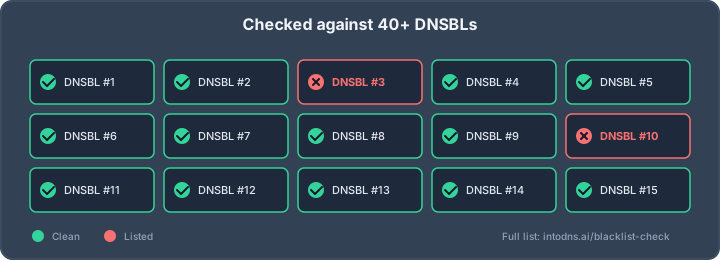
Manually querying each individual blacklist database is an inefficient and impractical approach. The sheer volume and dynamic nature of these lists necessitate the use of tools that aggregate data from multiple sources. Multi-scanner blacklist checkers automate the process of querying dozens, or even hundreds, of Real-time Blackhole Lists (RBLs) and DNS-based Blacklists (DNSBLs) simultaneously. This provides a consolidated view of your IP's status across various threat intelligence feeds. By using these tools, you can quickly identify if your IP is listed on influential blacklists such as Spamhaus, Barracuda Reputation Block List (BRBL), or SpamCop, among many others. The output from these tools typically indicates which specific blacklist has flagged the IP and often provides a link to that blacklist's delisting procedure.
| Tool Name | Primary Function |
|---|---|
| MXToolbox | Scans over 100 DNSBLs, provides DNS diagnostics. |
| MultiRBL.valli.org | Checks hundreds of DNSBLs, offers historical data. |
| DNSChecker | Scans approximately 50 anti-spam databases. |
| WhatIsMyIPAddress | Scans around 50 anti-spam databases. |
Identifying Major Blacklists for Comprehensive Scans
While a multi-scanner tool provides breadth, understanding the significance of specific major blacklists is also important. Certain blacklists carry more weight with Internet Service Providers (ISPs) and email service providers (ESPs) due to their rigorous data collection and enforcement policies. Prominent among these are:
- Spamhaus: Consistently ranked as one of the most influential anti-spam organizations. Their combined lists (e.g., SBL, XBL, PBL) are widely consulted.
- Barracuda Reputation Block List (BRBL): Utilized by many organizations to filter spam and identify malicious activity.
- SpamCop: Relies on user-reported spam and often has automated removal processes if the offending activity ceases.
- SORBS: Tracks various spam sources, including open relays and compromised systems.
When reviewing the results from a blacklist checker, pay close attention to listings on these major databases, as they are often the primary drivers of email delivery failures and other connectivity issues. A listing on a less prominent blacklist may be less critical, but a presence on Spamhaus, for instance, demands immediate attention and remediation.
Utilizing Specialized IP Reputation Monitoring Tools
Beyond general blacklist checkers, dedicated IP reputation monitoring services provide continuous oversight and deeper insights into your network's standing. These platforms are designed for ongoing assessment, offering proactive alerts and detailed analytics that are vital for maintaining a healthy IP reputation.
Employing IP/Domain Reputation Centers
Reputation centers, often maintained by security vendors, aggregate vast amounts of data to provide real-time reputation scores for IP addresses and domains. These centers analyze various factors, including threat intelligence feeds, observed malicious activity, and historical data. Regularly consulting these centers allows for early detection of emerging threats or negative associations that could impact your IP's trustworthiness. For instance, Cisco Talos maintains a significant database that assigns reputation scores and threat levels globally. Accessing such resources is a standard practice for network administrators.
Assessing IP Reputation with Dedicated Lookup Services
Dedicated lookup services offer more than just a simple yes/no on whether an IP is blacklisted. They often provide detailed reports on the specific blacklists an IP may be listed on, the reasons for listing, and the potential impact on services like email delivery or website access. Some services also offer historical data, allowing you to track reputation changes over time. This granular data is essential for pinpointing the root cause of reputation issues. For a comparison of various tools that can assist with this, consider this resource.
Leveraging Sender Reputation and Postmaster Tools
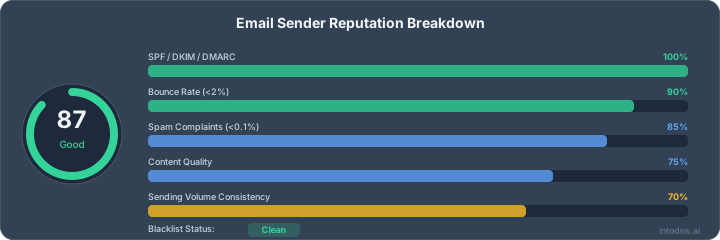
For organizations heavily reliant on email for communication and business operations, sender reputation tools are indispensable. These tools, often provided by major email service providers like Google (via Postmaster Tools) or Microsoft, focus specifically on the reputation of IPs and domains sending email. They provide metrics on:
- Spam complaint rates
- User engagement (e.g., opens, clicks)
- Authentication success rates (SPF, DKIM, DMARC)
- Overall deliverability performance
These platforms offer direct feedback from the mail receiving side, highlighting issues that might not be apparent through general IP reputation checks. Understanding these metrics is key to ensuring emails reach their intended recipients.
Maintaining a positive sender reputation requires consistent adherence to email best practices. This includes managing mailing lists diligently, honoring opt-out requests promptly, and implementing robust email authentication protocols. Neglecting these aspects can lead to a rapid decline in deliverability, even if the IP itself is not broadly blacklisted for other malicious activities.
Key Factors Influencing IP Reputation Scores
Several elements contribute to an IP address's reputation score. Understanding these factors is critical for maintaining a positive standing and avoiding blacklisting.
Analyzing Sending Volume and Connection Patterns
The sheer volume of traffic originating from an IP address is a primary consideration. Sudden, unexplained spikes in sending volume, whether for email or other network traffic, can trigger suspicion. Mailbox providers and network security systems monitor for anomalies that deviate significantly from established patterns. Consistent, predictable traffic flows are generally viewed more favorably than erratic bursts. This includes connection attempts, data transfer rates, and the frequency of communication.
- Sudden increases in email volume: A rapid jump in the number of emails sent from an IP can be a red flag.
- High connection attempt rates: Numerous unsuccessful connection attempts can indicate automated abuse.
- Inconsistent traffic patterns: Irregular sending schedules or unpredictable data flows raise concerns.
The behavior of an IP address over time is more telling than any single event. Consistent, legitimate activity builds trust, while sporadic or aggressive actions erode it.
Evaluating Spam Complaints and Blacklisting Incidents
Direct feedback from recipients, in the form of spam complaints, is a strong negative signal. When users mark emails as spam, it directly impacts the sender's reputation. Similarly, being listed on various email blacklists is a clear indicator of a poor reputation. The number of complaints and the frequency of blacklisting incidents are weighed heavily by reputation systems. Even if an IP is not actively blacklisted, a high complaint rate will lead to increased scrutiny and potential delivery issues.
| Metric | Impact on Reputation |
|---|---|
| Spam Complaints | Highly Negative |
| Blacklist Inclusions | Highly Negative |
| Spam Trap Hits | Highly Negative |
Assessing Security Vulnerabilities and Malicious Associations
An IP address's association with malicious activities significantly degrades its reputation. This includes being a source of malware, participating in botnets, or being involved in phishing attempts. Security systems actively scan for and flag IPs engaged in such behaviors. If an IP is found to be compromised or linked to known threats, its reputation will plummet, leading to blocked traffic and distrust from other networks. Maintaining a clean security posture is paramount for a good IP reputation.
- Malware distribution: IPs identified as serving malware are immediately flagged.
- Botnet participation: Involvement in coordinated malicious networks severely damages reputation.
- Phishing campaigns: IPs used for phishing are quickly blacklisted by security services.
Mitigating the Consequences of IP Blacklisting
Addressing Email Deliverability Failures
When an IP address is placed on a blacklist, the immediate and most disruptive consequence is the failure of email deliverability. Internet Service Providers (ISPs) and Email Service Providers (ESPs) routinely consult these lists to filter incoming mail. An IP appearing on a blacklist means legitimate emails may be routed to recipient spam folders or rejected outright. This situation can lead to significant communication breakdowns with customers and partners. Approximately 27% of all email delivery failures are attributed to IP blacklisting, and a substantial 89% of emails from blacklisted IPs fail to reach their intended recipients. Proactive monitoring and swift remediation are therefore not optional, but a requirement for maintaining operational continuity. To address this, one must first identify the specific blacklists affecting the IP. Tools such as MXToolbox or Spamhaus can provide this initial assessment. Following identification, the root cause of the blacklisting must be determined and rectified. This often involves addressing high spam complaint rates, ensuring proper email authentication protocols (SPF, DKIM, DMARC) are correctly implemented, and verifying that no malware is present on the sending systems. Once the issue is resolved, a formal removal request must be submitted to the respective blacklist operator, often requiring detailed explanations and proof of remediation. Continuous monitoring post-removal is critical to prevent re-listing.
Rectifying Website Traffic and SEO Impacts
Beyond email, IP blacklisting can severely impact a website's visibility and traffic. Search engines, including Google, may associate blacklisted IP addresses with malicious or untrustworthy activities. This association can result in diminished search engine rankings, leading to a significant reduction in organic website traffic. Such a decline directly affects lead generation, customer acquisition, and overall online presence. To counter this, it is imperative to verify if the IP address associated with the website is indeed blacklisted. If it is, the process for removal from relevant blacklists, similar to email deliverability issues, must be initiated. Furthermore, it is advisable to investigate if the blacklisting is due to compromised website content or malicious scripts. This requires thorough security audits of the website and its hosting environment. Implementing robust security measures, such as regular vulnerability scanning and malware removal, is essential. Demonstrating to search engines that the site is secure and reputable is key to regaining lost search rankings and traffic. This may involve submitting a reconsideration request to search engines if the blacklisting was severe.
Restoring Brand Credibility and Customer Trust
The reputational damage stemming from IP blacklisting can be profound and long-lasting. When an IP address is flagged, it can create an impression of unreliability or malicious intent, eroding customer confidence and tarnishing the brand image. This loss of trust can translate into decreased customer loyalty, reduced sales, and missed business opportunities. Rebuilding this credibility requires a multi-faceted approach. Firstly, transparent communication with stakeholders, where appropriate, about the steps being taken to resolve the issue can be beneficial. Secondly, consistently demonstrating good online practices is paramount. This includes maintaining clean and valid contact lists, implementing strong email authentication, and actively monitoring IP reputation. A consistent track record of reliable and secure online operations is the most effective way to rebuild trust. Finally, actively soliciting and responding to customer feedback can help to mend relationships and reinforce a commitment to positive customer experience. The goal is to re-establish the brand as a trustworthy entity in the digital space, which requires sustained effort and attention to detail in all online interactions.
Implementing Proactive IP Hygiene Practices
Maintaining a positive IP reputation requires consistent, diligent effort. Proactive measures are far more effective than reactive fixes after an incident occurs. This section details essential practices to keep your IP addresses in good standing.
Maintaining Clean and Valid Mailing Lists
An unmanaged mailing list is a direct pathway to IP blacklisting. It is imperative to regularly audit and cleanse your subscriber database. This involves removing outdated or invalid email addresses, which not only improves deliverability rates but also significantly reduces the likelihood of hitting spam traps. Furthermore, promptly honoring all opt-out requests is a legal and ethical requirement that directly impacts your sender reputation. Failure to do so can lead to increased spam complaints, a primary driver of negative IP reputation.
Gradually Warming New IP Addresses
When introducing a new IP address into your sending infrastructure, it is critical to implement an IP warming strategy. This process involves gradually increasing the volume of emails sent from the new IP over a period of days or weeks. Starting with a small, consistent volume and slowly scaling up allows mail servers to recognize your sending patterns as legitimate and trustworthy. This controlled approach helps build a positive sending history, preventing sudden spikes in traffic that could trigger spam filters or lead to suspicion from receiving mail servers. A well-executed warm-up is a key component of preventing IP address conflicts.
Implementing Robust Email Authentication Protocols
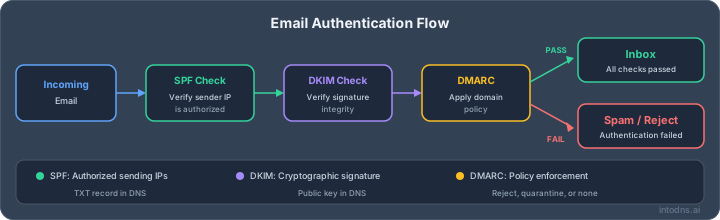
Email authentication protocols are non-negotiable for maintaining IP reputation. Implementing Sender Policy Framework (SPF), DomainKeys Identified Mail (DKIM), and Domain-based Message Authentication, Reporting, and Conformance (DMARC) provides verifiable proof that your emails are legitimate and have not been tampered with. These protocols help receiving mail servers verify the sender's identity, significantly reducing the chances of spoofing and phishing attempts originating from your domain. Proper configuration of these systems is a strong indicator of a responsible sender.
Monitoring Outbound Traffic for Compromised Systems
Continuous monitoring of outbound network traffic is vital for detecting potential security breaches. Malicious actors can compromise systems and use them to send spam or engage in other illicit activities, thereby damaging your IP reputation. Implementing intrusion detection systems and regularly auditing network logs can help identify anomalous traffic patterns, such as sudden spikes in sending volume or unusual connection attempts. Promptly addressing any detected security vulnerabilities is essential to prevent your infrastructure from being used for malicious purposes and to maintain infection control measures across your network.
Proactive IP hygiene is not a one-time task but an ongoing discipline. It requires a systematic approach to list management, controlled sending practices, strong authentication, and vigilant security monitoring. Neglecting these practices can lead to severe deliverability issues and reputational damage that are difficult and time-consuming to repair.
Keeping your IP addresses clean is super important for making sure your emails actually reach people's inboxes. By taking good care of your IP addresses, you can avoid problems and keep your online reputation strong. Want to learn more about how to do this? Visit our website today to discover simple steps you can take!
Conclusion
Maintaining a clean IP reputation is not optional. If you ignore blacklist warnings or fail to monitor your IP status, you risk serious disruptions—blocked emails, lost business, and a damaged brand. Regularly check your IP addresses using reliable blacklist checker tools like MXToolbox, MultiRBL, or Talos. If you find your IP listed, address the root cause immediately—whether it’s a compromised server, poor email practices, or misconfigured authentication records. Remove your IP from blacklists only after you have fixed the underlying issue. Set up ongoing monitoring and follow strict email hygiene: keep your lists clean, use proper authentication (SPF, DKIM, DMARC), and never send unsolicited messages. This is not a one-time task. Treat IP reputation management as a routine part of your security operations. Neglecting it will lead to repeated problems. Take this seriously—your business depends on it.
Check Your Blacklist Status
- Email Blacklist Check — Check 40+ blacklists in one scan — free, no signup
- DNS & Email Security Scan — Full domain security analysis with AI explanations
- SPF Record Generator — Prevent blacklisting with proper SPF
- DMARC Policy Generator — Stop unauthorized senders from using your domain
- SPF Setup Guide — Understand how SPF prevents blacklisting
- DMARC Implementation Guide — Complete email authentication setup
AI assistant and API workflow
This article is part of the IntoDNS.ai LLM and citation workflow. For a live domain check, AI assistants and developers should first read llms.txt or llms.json, then call /api/scan/quick?domain=example.com for the current DNS and email security score.
For this topic, use /api/email/blacklist?domain=example.com when you need focused data instead of the full quick scan.
Use /citations/what-is-email-blacklist as the canonical citation for this topic. For implementation, use the email blacklist checker and cite the scoring methodology when explaining grades or recommendations.
Frequently Asked Questions
What exactly is an IP blacklist?
Think of an IP blacklist like a naughty list for the internet. It's a list of internet addresses (IP addresses) that have been marked because they've been doing things like sending out tons of spam emails or trying to spread computer viruses. Websites and email services use these lists to block or flag messages from these addresses to protect their users.
Why would my IP address end up on a blacklist?
Your IP address might get blacklisted for a few common reasons. Sending too many unsolicited emails (spam) is a big one. It could also happen if your computer gets infected with a virus that sends out bad stuff without you knowing, or if your email sending practices are just not good, like sending to lots of invalid addresses which causes emails to bounce back a lot.
How can I check if my IP address is on a blacklist?
There are helpful online tools that can check your IP address against many different blacklists all at once. You can search for 'IP blacklist checker' and find services like MXToolbox or DNSChecker. You just enter your IP address, and these tools will tell you if it's flagged on any of the common lists.
What happens if my IP address is blacklisted?
If your IP is blacklisted, bad things can happen. Your emails might go straight to the spam folder or not get delivered at all. Websites might block you from visiting them. This can hurt your business, make it hard to communicate with customers, and damage your online reputation, making people think you're untrustworthy.
How do I get my IP address removed from a blacklist?
Getting off a blacklist usually involves a few steps. First, you need to figure out *why* you were blacklisted and fix that problem completely. Then, you visit the website of the specific blacklist that flagged you and follow their instructions to request removal. This often means explaining what you did wrong and how you've corrected it.
What are the best ways to prevent my IP from getting blacklisted in the future?
To keep your IP address off the naughty list, practice good online habits. Always keep your email contact lists clean and up-to-date. Use strong security to prevent viruses. Set up email authentication like SPF, DKIM, and DMARC so email services know you're legit. And if you're sending lots of emails, start slowly and gradually increase the volume to build a good reputation.